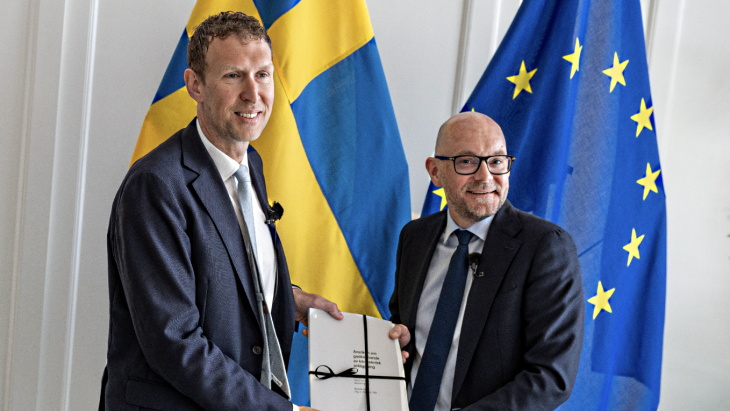
Swedish small modular reactor (SMR) developer Blykalla has filed a formal application with the government to build a nuclear power plant in Norrsundet, in the municipality of Gävle in east central Sweden. The proposed facility would house six of the company's lead-cooled SEALER reactors for a combined generating capacity of 330 MWe, marking what the developer calls a historic first for the country.
A first-of-its-kind application
Blykalla said it chose Norrsundet for its strategic position between two key electricity bidding zones, its existing port, established infrastructure and industrial heritage — factors the company argues will reduce construction complexity while addressing regional power shortages with predictable baseload supply. The plant is aimed squarely at hyperscale data centres and energy-intensive industries.
"This application is a historic first for Sweden," said Blykalla CEO Jacob Stedman. "We're not just planning an advanced reactor park — we're building Sweden's energy future and putting the country at the forefront of the global nuclear power renaissance." Stedman added that as "AI and electrification grow worldwide, we need to accelerate the deployment of predictable, clean baseload power."
Inside the SEALER design
Blykalla — formerly known as LeadCold — is a spin-off from the KTH Royal Institute of Technology in Stockholm, where lead-cooled reactor systems have been under development since 1996. Founded as a joint stock company in 2013, the firm is developing the SEALER, or Swedish Advanced Lead Reactor. A demonstration unit, SEALER-D, is planned with a thermal output of 80 MW. The compact, lead-cooled architecture is being positioned as a fossil-free source of reliable power, echoing the appeal driving SMR projects elsewhere such as the NANO Nuclear KRONOS microreactor now entering formal NRC review in the United States.
A multi-agency approval process
Sweden's Ministry of Climate and Enterprise said the government will now assess whether the application meets the relevant requirements, whether the proposed activity is justified, and whether there are adequate conditions for emergency preparedness and for handling nuclear material and waste. The review launches a comprehensive approval process involving multiple bodies, including the Land and Environmental Court and the Swedish Radiation Safety Authority, after which the government will produce a facility plan to guide land and water use. The municipality of Gävle must approve both the plan and the application before the government can authorise the facility. Subject to permits and a final investment decision, the Norrsundet plant could become operational in the first half of the 2030s.
Sweden's nuclear revival gathers pace
The filing comes amid a broader push to expand Swedish nuclear capacity. In February the government proposed measures to ease the establishment of new nuclear power, introducing an early-stage approval process designed to improve predictability. The following month, rival developer Kärnfull Next submitted the first application under the new Act on Government Approval of Nuclear Facilities — the first application for new nuclear power in Sweden in 50 years. A 2023 roadmap envisages capacity equivalent to at least two large-scale reactors by 2035 and up to 10 by 2045, with SMRs expected to play a central role. The momentum mirrors government-backed support seen internationally, from the U.S. Department of Energy's recent $94 million in SMR deployment awards to fresh capital flowing into ventures such as Deep Fission's planned Nasdaq listing for its borehole reactors.
Reporting based on coverage from World Nuclear News and the Swedish Ministry of Climate and Enterprise.