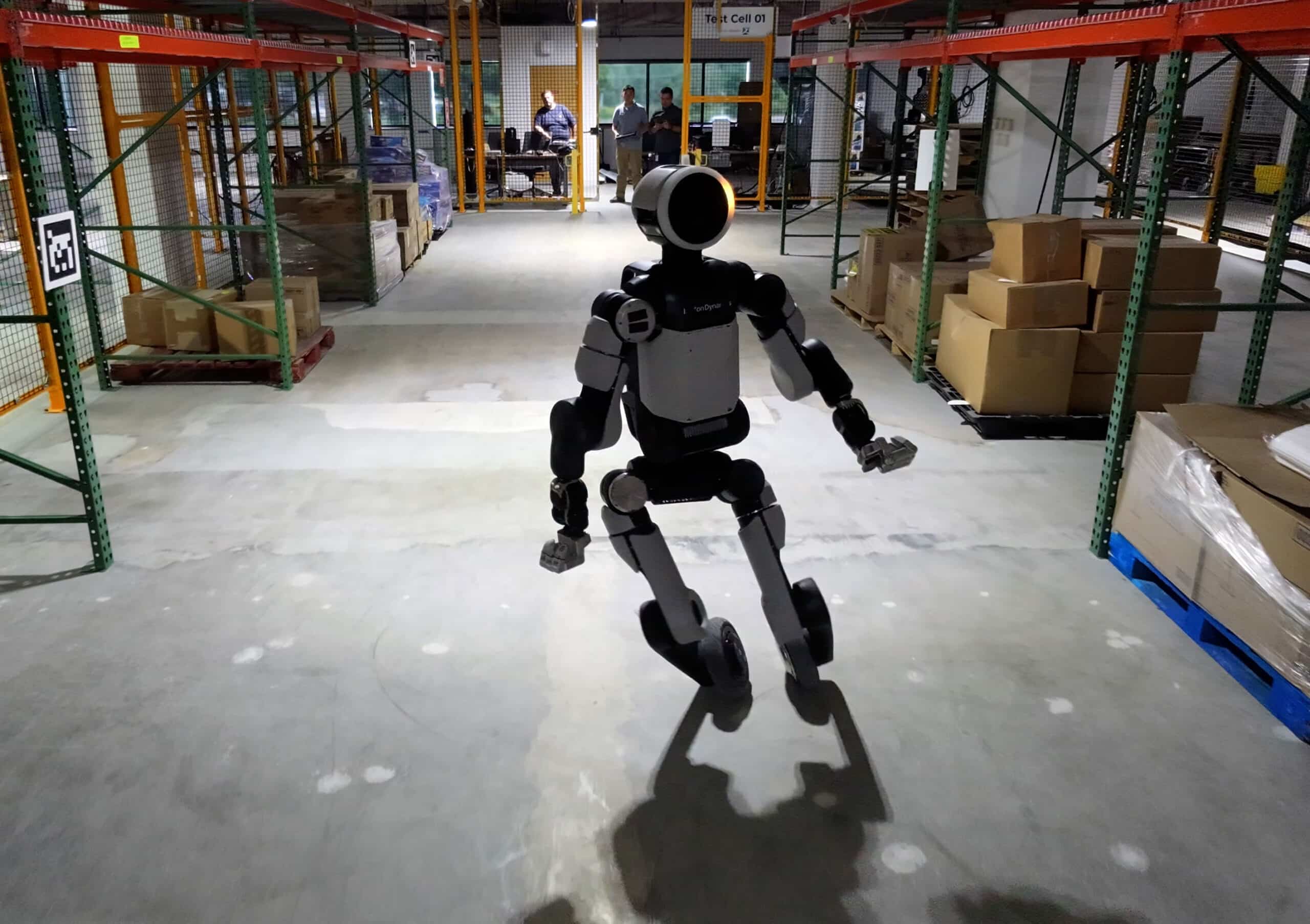
Boston Dynamics has bolted scooter wheels onto its Atlas humanoid robot, not to sell a wheeled version, but to find out exactly how hard its actuators can be pushed before they break. The company detailed the project in a blog post titled "Atlas On a Roll," showing Atlas rolling backward, sliding sideways and pulling off a 360-degree spinning jump using wheels instead of feet.
What did Boston Dynamics actually change on Atlas?
Engineers replaced Atlas's feet with off-the-shelf scooter rims, attached through custom adapters to the robot's existing ankle actuators. No new motors or joints were added. In the control system, each wheel is modeled as a continuously spinning "ankle," letting the same hardware that normally balances Atlas on two feet instead roll, drift and skate across the floor.
Why wheels, and why now?
Controls engineer Xiaoyu "Andy" Wu said the wheels were never the goal. "The wheels weren't really the point of this," Wu said. "The point was pushing the actuation to its limits." Rolling motion lets Atlas's motors spin continuously across a much wider torque-and-speed range than walking does, which makes it a stress test for actuator reliability and for how well a reinforcement learning controller trained in simulation survives contact with real hardware.
The team trained its whole-body controller through millions of simulated trials before ever touching the physical robot, drawing on a motion-capture library of human movements that included foot-sliding maneuvers. Reward functions and command ranges were then retuned specifically for rolling behavior, including the sequence that produces the 360-degree jump, which uses a trajectory-tracking policy built from recorded human motion.
What's the catch with training robots in simulation?
Boston Dynamics says the project exposed a specific failure mode: if a simulated motor behaves even slightly differently from the real one, a reinforcement learning policy can learn movements the physical actuator simply cannot execute. Accurate motor modeling, not just more training data, turned out to be the deciding factor in whether skills transferred from simulation to the wheeled Atlas on the shop floor. That finding is already feeding back into Boston Dynamics' standard bipedal Atlas work, where the goal is a controller that responds gracefully to actuator failures and unexpected terrain rather than falling over.
Does this mean Boston Dynamics is building a wheeled robot?
No. The company has been explicit that "a wheeled Atlas isn't a product. It's a research testbed." Atlas remains a bipedal platform aimed at warehouse and manufacturing work, including an upcoming 2027 deployment inside GlobalFoundries chip plants. The wheel experiment sits alongside that commercial track as a way to wring more performance data out of the same hardware before it ever reaches a customer floor. For an industry racing to prove humanoid robots can survive real factory conditions, a scooter-wheeled Atlas sliding sideways is less a party trick than a cheap way to find the breaking point of a very expensive robot before a customer does.