Persona AI, a Houston-based humanoid robotics startup, has shipped its second-generation bipedal welding robots to South Korea, where they are training alongside expert welders inside HD Hyundai Robotics facilities. The robots passed enterprise-grade quality validation in September 2026, and the companies are targeting commercial deployment by the end of the year, according to a report by Seoul Economic Daily.
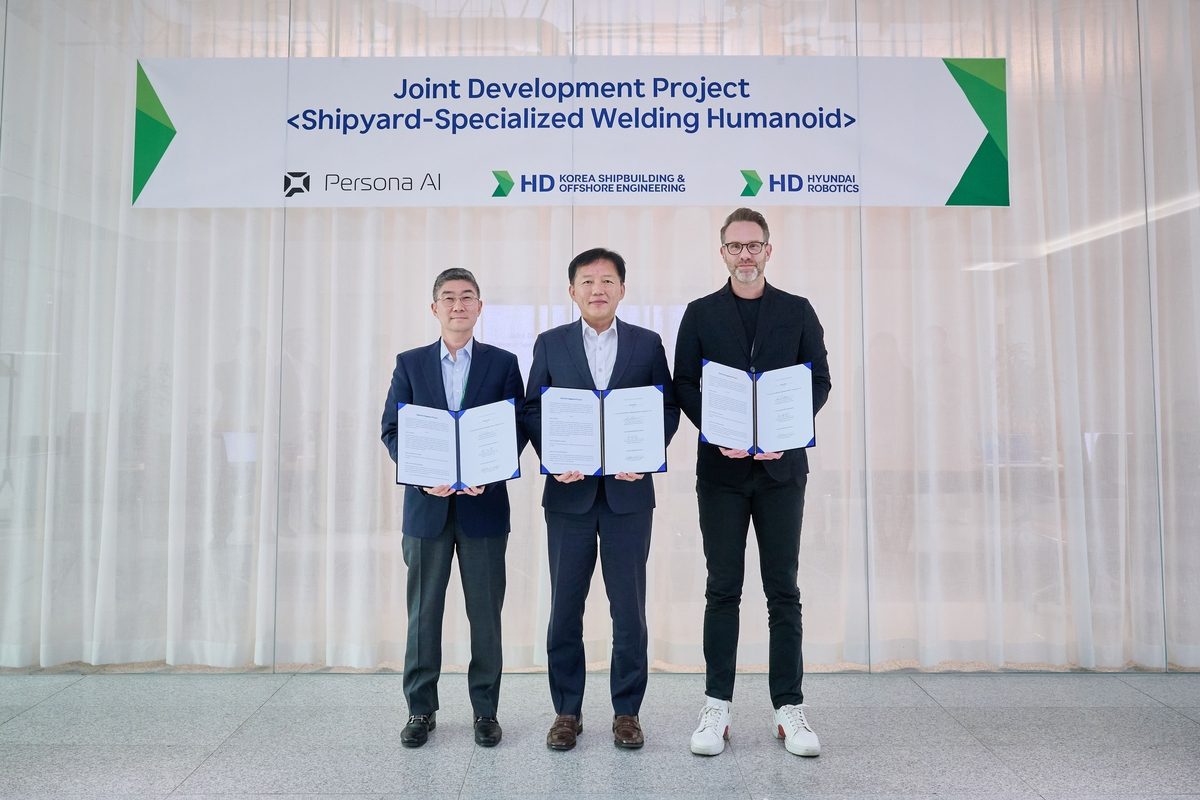
The robots are the product of a partnership formalized in March 2026 between Persona AI, HD Korea Shipbuilding & Offshore Engineering, and HD Hyundai Robotics. The current hardware generation, built in May 2026, carries a wire-feeder assembly weighing 15 kilograms and is built to work inside shipyard infrastructure originally designed for human welders.
Why Shipyards, Not Factories
Most humanoid robot demonstrations to date favor relatively structured environments: car assembly lines, warehouse aisles, chip fabs with flat floors and predictable layouts. Shipbuilding is messier. Welders climb into tight hull sections, work overhead and underfoot, and face different joint geometry on every vessel. Persona AI's wager is that a bipedal platform, not a wheeled cart or rail-mounted arm, is the only form factor that can move through that environment without rebuilding the yard around it.
Persona AI commercial strategy chief Michael Patrick put the logic plainly: "One thing that isn't discussed enough about humanoids is the ability to do work using existing infrastructure designed for humans." He also acknowledged the hard part has not been welding itself but locomotion: "If mobility were fully solved, the job would be far easier."
That comment cuts against some of the marketing around humanoid robots, where walking is often treated as solved and manipulation as the remaining challenge. Persona AI's experience in a shipyard suggests the opposite ordering, at least for this task.
South Korea's Labor Math
South Korea's shipbuilders, HD Hyundai chief among them, face an aging and shrinking pool of skilled welders even as order books for LNG carriers and naval vessels stay full. HD Hyundai Robotics already builds industrial robots and automation equipment for its own yards, giving it both a customer relationship and a manufacturing partner baked into the deal before Persona AI shipped a single unit.
That is a different path than most humanoid startups are taking. Figure and Apptronik have leaned on car plants and warehouse logistics; Agility Robotics built toward Amazon-style fulfillment. Persona AI is starting from a vertical, shipbuilding, where the end customer co-develops the hardware rather than buying a general-purpose platform off a catalog. HD Hyundai's own classification-society collaborator, ABS, has separately signaled interest in testing humanoid robots for shipyard work, suggesting the application has attention beyond this one partnership.
Persona AI closed $25 million in pre-seed funding earlier in 2026, with RTX Ventures among the backers. Whether a narrow, deep partnership model outcompetes the broader horizontal plays other humanoid makers are pursuing will depend on how well the robots hold up once HD Hyundai moves past training and into production welds on real hulls.