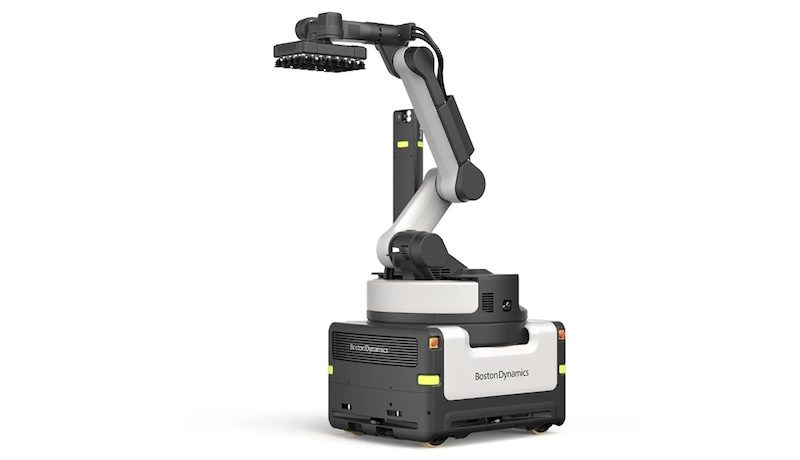
Boston Dynamics unveiled Stretch Gen 2 on November 19, 2026, a rebuilt version of its trailer-unloading robot engineered from data gathered across more than 100,000 operating hours and tens of millions of boxes handled by the first generation. The new model keeps the same job — pulling boxes off cardboard-packed trailers at up to 1,000 cases an hour — but changes nearly everything underneath the skin to stay running longer between failures.
The headline number is cabling. Boston Dynamics says it stripped out 81% of the robot's internal wiring, roughly half a mile of cable, replacing dynamic harnesses with automotive-grade connectors built to survive vibration and torque. Continuous rotation joints now spin past 360 degrees instead of hitting hard stops, and a redesigned gripper adds new valve systems and sensing. Brian Donnelly, the company's vice president and general manager of logistics robotics, said the team "focused on the things that actually took robots offline," aiming to make the machine "tougher" and "simpler to service," according to Robotics and Automation News.
Why Boston Dynamics Is Optimizing for Downtime, Not Capability
Stretch Gen 1 already leads its category by deployment count, which gives Boston Dynamics something few logistics robot makers have: a large installed base generating real failure data instead of lab assumptions. Gen 2 reads like a maintenance product disguised as a robot. A full swerve-drive swap now takes about an hour instead of a full day. Fasteners are standardized to cut tool changes, exterior panels use new materials to stop accidental safety triggers, and the recessed, lower-positioned emergency stop addresses a design detail that sounds minor until it's the reason a line goes down twice a shift.
The battery numbers matter just as much as the mechanics. Stretch Gen 2 runs two full shifts on a charge and hits 90% capacity in about 75 minutes on a fast charger — figures aimed at operators who schedule robots the way they schedule forklifts, around uptime windows rather than novelty. The timing lines up with peak holiday shipping season, when trailer volume spikes and labor shortages are most acute for third-party logistics providers, the exact conditions that make reliability, not top-line speed, the selling point.
The Competitive Picture in Warehouse Unloading
Trailer unloading is one of the few robotics tasks with an unambiguous ROI case: repetitive, physically brutal on human workers, and happening at predictable volume. That has drawn competitors including Dexterity and Pickle Robot into the same slice of the warehouse, each betting on different combinations of vision systems and arm design to handle irregular box stacks. Boston Dynamics' edge is less about raw unloading speed — 1,000 cases an hour is competitive but not unprecedented — and more about fleet-scale reliability data that smaller rivals haven't accumulated yet.
That's also the company's pressure point. Hyundai, which completed its full buyout of Boston Dynamics, is pushing toward profitability, and logistics robots are the nearest-term revenue engine while humanoid platforms like Atlas remain earlier-stage. A pre-trained vision system that needs no initial programming lowers integration costs in warehouses with scarce IT resources for custom computer vision. The real test won't be a trade-show demo — it'll be whether warehouse maintenance teams, not Boston Dynamics field engineers, can keep Gen 2 running under six months of heat, dust and forklift traffic.