BrightAI has raised $97 million in a growth round led by Smith Point Capital, pushing the physical AI startup's total funding to $184 million and its valuation to $750 million. The round, announced November 18, 2026, also drew new money from Cobalt Capital, Marlinspike Partners, Zero Infinity Partners and existing customer GE Vernova, alongside returning backers Khosla Ventures, Inspired Capital and Upfront Ventures.
Founded in 2019 by Alex Hawkinson, who previously built and sold home-sensor company SmartThings to Samsung in 2014, BrightAI bootstrapped for its first four years before taking outside capital. The company has already booked more than $80 million in revenue, a rarity for an infrastructure-tech startup at this stage.
What does BrightAI actually sell?
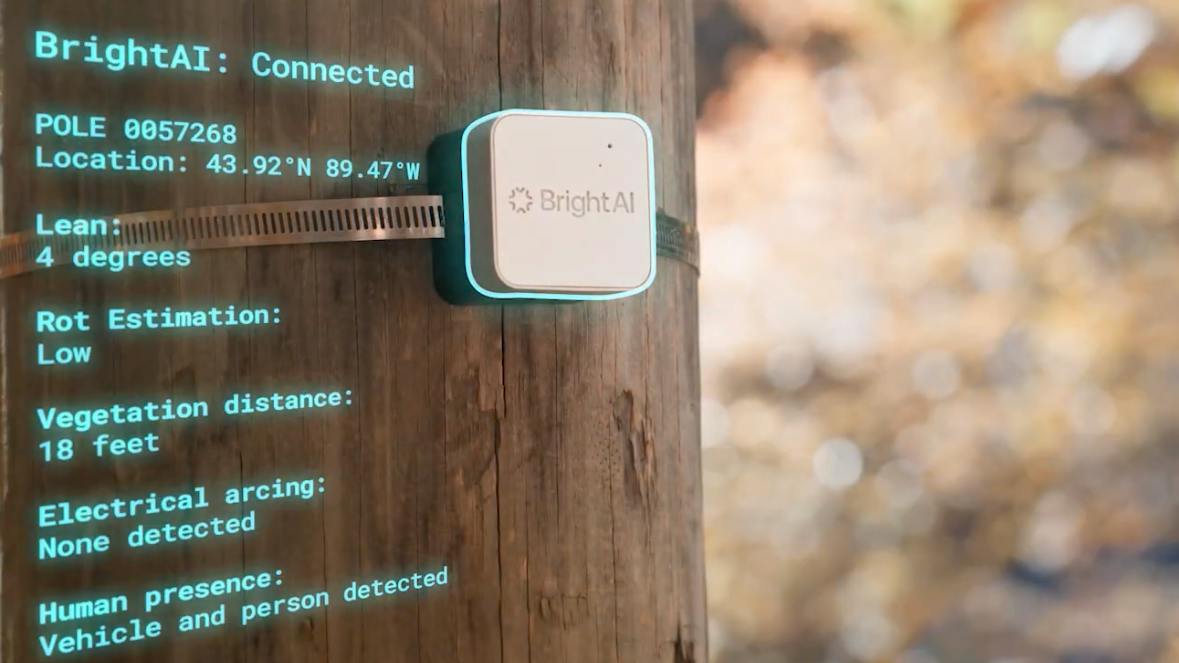
BrightAI's platform, called Stateful, pairs edge sensors bolted onto utility poles, pipelines, gas compressors and storage tanks with autonomous robots, drones and a wearable AI assistant for field technicians. Instead of an inspector walking a pipeline route once a quarter, a drone or crawling robot checks it continuously and flags corrosion, leaks or structural stress before they turn into failures.
The company says its systems now run across more than 50,000 locations, processing "tens of trillions" of sensor readings and guiding tens of thousands of field workers and autonomous machines. Customers include GE Vernova, waste firm Reworld, utility contractor Osmose Utilities Services, water company Azuria Water Solutions and gas-compression operator Kodiak Gas Services. BrightAI pitches the pitch around a single number: the firm estimates infrastructure failures cost the global economy $2.5 trillion a year, mostly from reactive fixes that could have been scheduled or avoided.
Why is this money going overseas?
Hawkinson has said Europe and Asia make up roughly 60% of BrightAI's addressable market, and the new capital is earmarked for opening offices and field operations in both regions rather than for new product lines. The company has also doubled its headcount over the past year to keep pace with deployments, and it plans to deepen its existing GE Vernova partnership, which spans power-generation and grid assets.
That international push puts BrightAI up against a crowded field of industrial-inspection players, from drone-inspection specialists like Percepto and Gecko Robotics to sensor-heavy asset-monitoring firms embedded inside utilities themselves. BrightAI's bet is that bundling sensors, robots and a human-facing AI copilot into one subscription is stickier than selling any single piece of hardware alone.
What happens next?
With $184 million raised and a $750 million valuation, BrightAI sits just short of unicorn status, something Hawkinson has downplayed publicly. The real test now is execution: whether the company can replicate its US deployment pace with European and Asian utilities that often have stricter procurement cycles and different regulatory requirements for autonomous field equipment. Investors will also be watching whether GE Vernova's involvement as both customer and backer translates into faster rollout across its own fleet of power assets.