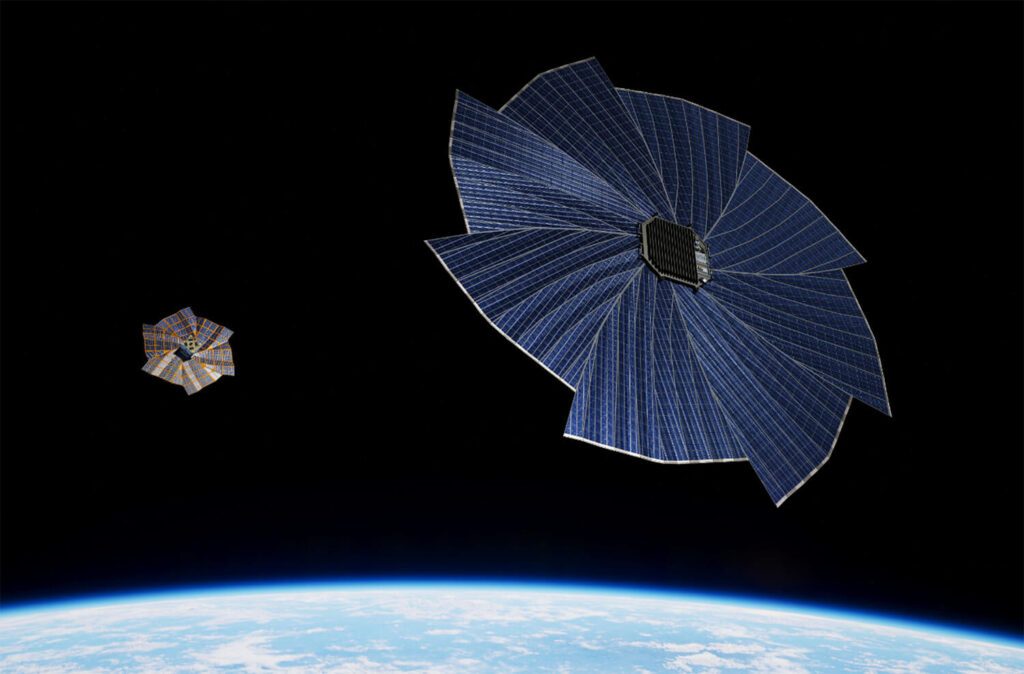
Dcubed, a German space-hardware company that builds release actuators and deployable structures for satellites, has raised an oversubscribed €27.2 million (about $29.4 million) Series A+ round led by Warsaw Equity Group. The round, announced November 18, 2026, also included the European Innovation Council Fund, the HTGF Opportunity Fund, and existing investors BayBG and Expansion.
The Bremen-based company, which also has operations in Denver, now employs 87 people and says more than 500 of its products are already flying in orbit across 170-plus customers worldwide. No valuation was disclosed.
What does Dcubed actually build?
Satellites need small mechanical devices to unfold solar panels, antennas and other hardware once they reach orbit, since nothing can be launched already extended inside a rocket's payload fairing. Dcubed makes these release actuators, the triggers that let folded components spring open on command, along with the deployable structures themselves.
The company's newest product line, ARAQYS, is a family of solar arrays built around an origami-style folding technique. Its first design, called HALO, folds a large photovoltaic surface into a compact launch volume and is scheduled to fly a 2-kilowatt in-orbit demonstration in 2027 aboard a SpaceX rideshare mission, alongside five power-beaming partners testing the system.
Why raise money for solar arrays right now?
CEO Thomas Sinn said demand for Dcubed's hardware is "going through the roof," and the company wants to make space hardware "as easy to buy and use as anything on Earth." That demand is tied to the broader boom in satellite constellations, where operators need cheaper, lighter, more reliable ways to deploy power systems without custom-engineering each mission.
The new capital is earmarked for two things: quadrupling manufacturing capacity for release actuators and solar arrays in Germany and the United States, and bringing the ARAQYS line fully to market. That means new production equipment, automation and additional hires in both countries, plus supply-chain work to keep up with order volume.
Who else is building this kind of hardware?
Dcubed competes with established deployable-structures suppliers like Redwire and MDA Space, as well as smaller specialists building folding solar arrays for small satellites. Its pitch is standardized, off-the-shelf components rather than bespoke engineering for every customer, a model that has let it reach 500-plus flown units already, a scale most rivals in the deployable-hardware niche haven't matched.
What comes next?
The real proof point is the 2027 HALO demonstration. If the origami-folded array performs as promised on orbit, Dcubed has a credible claim to a share of the fast-growing satellite power market, where constellation operators are increasingly comparing cost-per-watt and stowed volume as closely as they compare launch costs. A clean on-orbit test would also help justify the production buildout this round is funding.