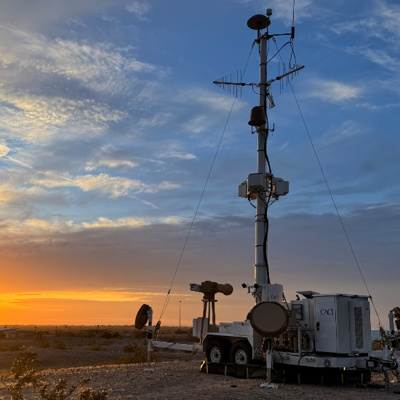
CACI International said Joint Interagency Task Force 401 (JIATF-401) awarded it a three-year, $500 million indefinite-delivery, indefinite-quantity contract for counter-drone systems, with an opening $25 million task order to deploy its SkyValor platform to defend critical U.S. mission sites and overseas bases.
Non-Kinetic C-UAS For Domestic Shield
SkyValor uses radio-frequency sensing and AI-driven electronic warfare to detect, track and defeat Group 1 and Group 2 unmanned aircraft — the small commercial and modified quadcopters and fixed-wing drones that have crowded U.S. base airspace in the last 18 months. Its non-kinetic architecture means no interceptors and no munitions, an important consideration for the Domestic Shield mission set that sits inside cities and near civilian airspace.
How It Got Here
JIATF-401 stood up the SkyValor selection after live evaluations at Marine Corps Air Station Yuma, where the system was tested against a range of small UAS threats beyond line of sight. Four earlier SkyValor units were already in the force's inventory, one truck-mounted for rapid repositioning. The IDIQ formalizes SkyValor as a program of record for the task force, which the Defense Department stood up in 2025 to lead counter-drone efforts across the homeland and overseas.

Where CACI Fits
SkyValor is one of several C-UAS families the Pentagon is scaling in parallel. The Robotics Media has tracked the wider push in DHS's $1.5B counter-UAS IDIQ split across 12 vendors, the JIATF-401 task force fielding drones at 46 sites, and the Marines' $19M V2X Tempest Counter-UAS truck buy.
What To Watch
Follow-on task orders will spell out how many SkyValors move where. CACI has said mobile truck-based variants will absorb near-term demand, with fixed-site sensors likely to follow at higher-priority bases.
Reporting based on coverage from Washington Technology, Breaking Defense, Defense Daily and CACI investor relations.