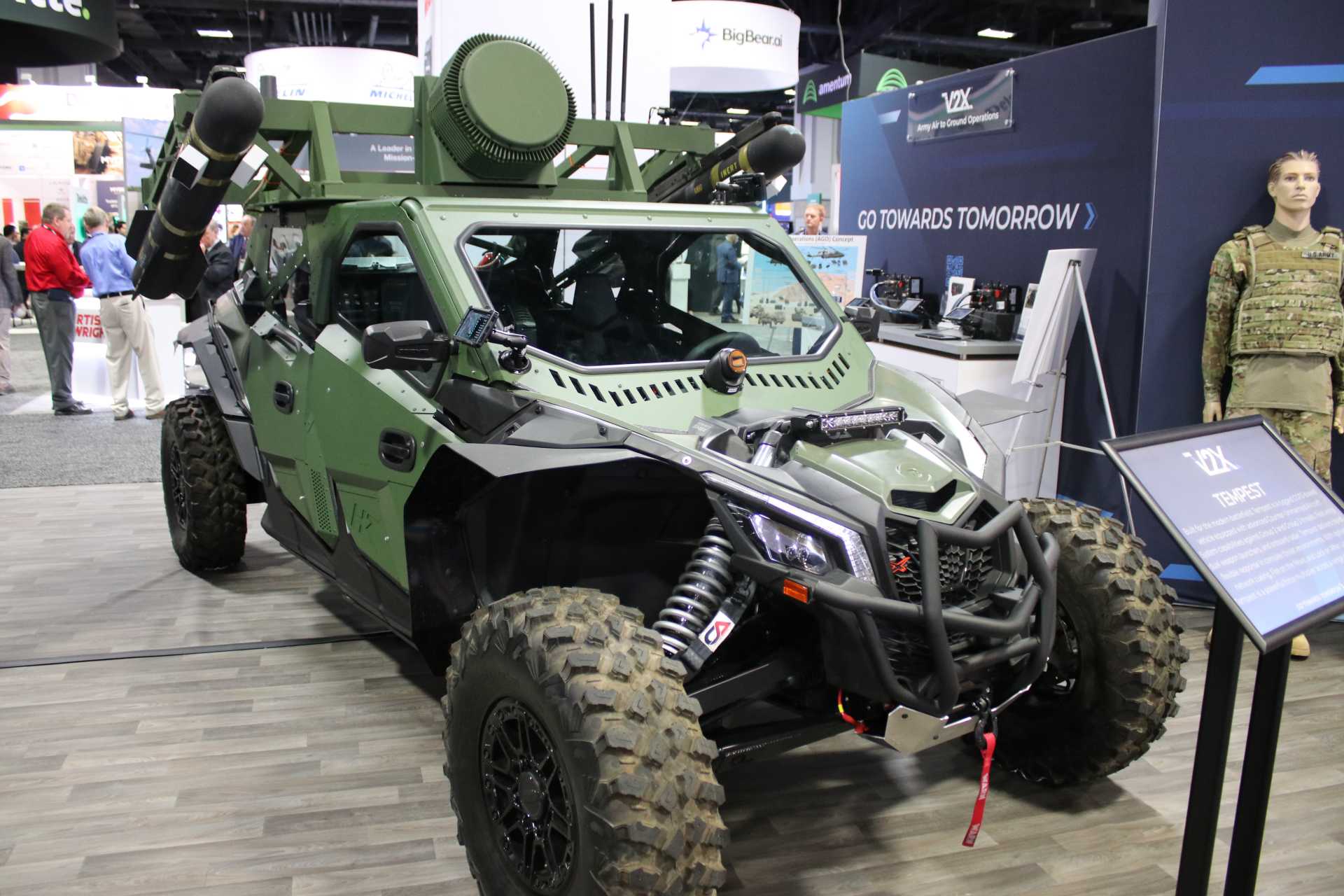
The U.S. Marine Corps has ordered 10 V2X Tempest counter-UAS vehicles from V2X subsidiary Vertex Modernization and Sustainment under a $19.06 million contract announced by the Pentagon on August 11, 2026. The award pushes Tempest from an industry-demonstrated concept toward operational fielding and gives Marine maneuver units another mobile kinetic option against larger unmanned aircraft.
What The Contract Buys
The award covers 10 Tempest vehicles plus software management, spare parts, ancillary equipment, training and services, with completion scheduled for August 10, 2027. That mix of hardware, software and services means the $19.06M figure cannot be read as a clean per-vehicle price. Because the contract also bundles interceptor-related logistics, the final missile configuration for the Marine order remains unconfirmed — Tempest has previously been shown carrying AGM-114L Longbow Hellfire missiles.
Where Tempest Fits
Tempest is a rugged, commercially derived vehicle equipped with dual weapon launchers and designed to engage Class 2 and Class 3 drones before displacing rapidly to reduce crew exposure. That profile makes it a more focused kinetic shooter than the Marine Air Defense Integrated System (MADIS), a two-vehicle Joint Light Tactical Vehicle package that combines sensors, command-and-control, electronic-warfare tools, Stinger missiles and a 30mm cannon.
Rather than replacing MADIS, Tempest looks set to add missile-equipped firing positions that can accompany maneuver units and reposition as drone threats shift. The result is more mobile kinetic options within a layered short-range air-defense network that already includes MADIS, Stinger teams and electronic warfare, echoing the same layered logic driving programs like Epirus's HAVOC high-power microwave contract and the DHS $1.5B counter-drone IDIQ.

The Unresolved Details
The Pentagon notice does not identify which Marine unit receives the first 10 vehicles, and it does not lock in the final production chassis, sensor package or reload arrangement. Whether Tempest relies on organic sensors or accepts external tracks from wider Marine air-defense networks will shape whether the platform behaves as a stand-alone shooter or as a networked firing element — a distinction reinforced by the software-management line item baked into the award.
The buy is nevertheless notable procurement momentum. Alongside recent counter-drone deals such as AeroVironment's $80.5M Titan task order and Kratos's $156M NNSA award, Tempest reinforces how quickly the U.S. is fielding mobile kinetic C-UAS after two years of frontline lessons from Ukraine, where V2X's system has already been deployed.
Reporting based on coverage from Army Recognition and Pentagon contract announcements.