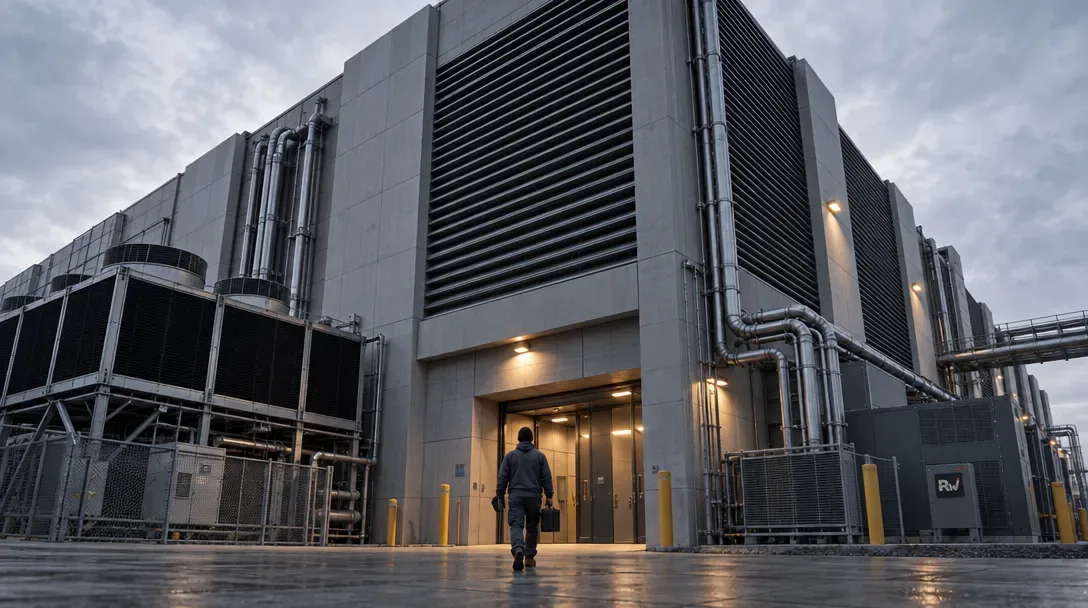
Darwin Robotics, a San Francisco startup building robots to perform physical maintenance work inside data centers, raised a $3.6 million pre-seed round led by Link Ventures, with Y Combinator, Liquid 2 Ventures, Rebel Fund, Globivest and Script Capital also participating. The round was announced November 6. Founded by brothers Sergio and Luigi Charles — Sergio with an AI and robotics research background spanning Stanford, Google X and Nvidia — Darwin is building what it calls general-purpose robot technicians trained from human demonstrations, designed to install fiber optic connections, replace failed server components, and handle cable and rack work. The company is targeting initial deployments at a named data center operator in early 2027, according to Y Combinator.
Why Data Centers Are the Next Robotics Frontier
Global data center capacity is projected to nearly double by 2030, from roughly 103 to 200 gigawatts, and every gigawatt of new capacity needs technicians to rack servers, pull cable, and swap failed components around the clock. That labor demand is outrunning the hiring pipeline, which is exactly the kind of narrow, repetitive, physically demanding task set that robotics companies have learned to target first — the same logic that pushed Amazon, GXO and Schaeffler toward humanoid robots on warehouse and factory floors rather than open-ended domestic tasks.
Darwin's bet is that data center maintenance is a cleaner environment than a warehouse: structured racks, predictable layouts, and tasks that repeat constantly across thousands of identical server rows. That structure should make it easier to collect training demonstrations and generalize across sites than, say, teaching a humanoid to fold laundry or navigate a disaster zone.
A Narrow Niche in a Crowded Field
Darwin isn't the only startup chasing physical infrastructure labor. Aformic has built a backlog automating forklift work destined for data centers, and general-purpose humanoid makers like Agility and Figure have pitched their robots at logistics and light-manufacturing tasks that could eventually extend into server-room work. Darwin's advantage is specificity — it isn't trying to build a robot that does everything, just one that does data center technician work well, which should shorten the path to a working demo but also caps its addressable market more tightly than general-purpose rivals.
The trade-off is proof. A $3.6 million pre-seed buys very little hardware iteration, and the company's deployment-first approach — starting under human supervision in live facilities before reducing it — means its real test comes in 2027, not now. With only four employees, Darwin is betting that a tightly scoped task and a named operator will get it to a working deployment faster than competitors spreading their robots across multiple industries at once.