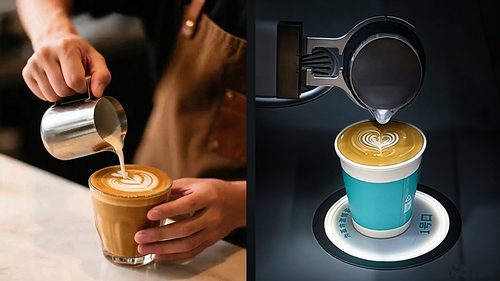
COFE+, a seventh-generation robotic barista made by Shanghai Hi-Dolphin Robot Technology, beat an award-winning human barista on speed, precision and consistency in a live head-to-head competition on Nov. 14, 2026, at the 7th LD International Coffee Masters Competition, part of the China Yiwu Imported Commodities Fair. The company announced the results on Nov. 20, 2026, via PR Newswire.
Across five drinks, COFE+ was faster on every one: an espresso in 30 seconds versus 32 for the human champion, a cappuccino in 36 versus 40, a classic latte in 43 versus 48, a swan-design latte art pour in 70 versus 88, and a 3D-printed Audrey Hepburn portrait latte in 68 versus 78. On consistency, measured across five prepared lattes, COFE+ posted a standard deviation of 1.72 grams compared with 7.61 grams for the human barista, a gap of roughly 4.4 times.
Why a coffee contest is a useful robotics benchmark
Latte art and portrait lattes are a deliberately hard test for a robotic arm: they require consistent pressure, timing and fine motor control while working with a liquid medium that behaves differently from the rigid objects most industrial robots manipulate. COFE+ uses a six-axis robotic arm to handle grinding, extraction, milk steaming, beverage assembly and the latte art itself, essentially packaging a full barista workflow into one automated station rather than a single repetitive task like most food-service robots attempt.
The standard-deviation numbers matter more than the speed gap for a commercial pitch. Restaurants and cafes care less about shaving a few seconds per drink than about guaranteeing every customer gets the same quality regardless of staff turnover, fatigue or rush-hour pressure. A machine that is four times more consistent than a trained, award-winning professional is a stronger argument for unattended or lightly staffed coffee kiosks than raw speed alone.
Where this fits in the crowded service-robot market
Robotic coffee machines and kiosks are not new; companies from Cafe X to various automated kiosk operators have tried the format with mixed commercial traction, often struggling with throughput during peak demand or with the capital cost of a dedicated booth. COFE+'s pitch leans on the competition framing itself: beating a named, award-winning barista under judged conditions is a more concrete claim than typical marketing comparisons, and it gives Shanghai Hi-Dolphin a data point to shop to retail and hospitality operators evaluating automated beverage stations.
The bigger test will be commercial deployment at scale rather than a single showcase event. A controlled competition format rewards precision and repeatable choreography, conditions a robot is well-suited to win. Real cafes bring variable cup placement, restocking, cleaning and maintenance demands that a trade-show demonstration doesn't have to handle, and that gap is where most robotic food-service ventures have historically struggled to turn a strong demo into sustained unit economics.