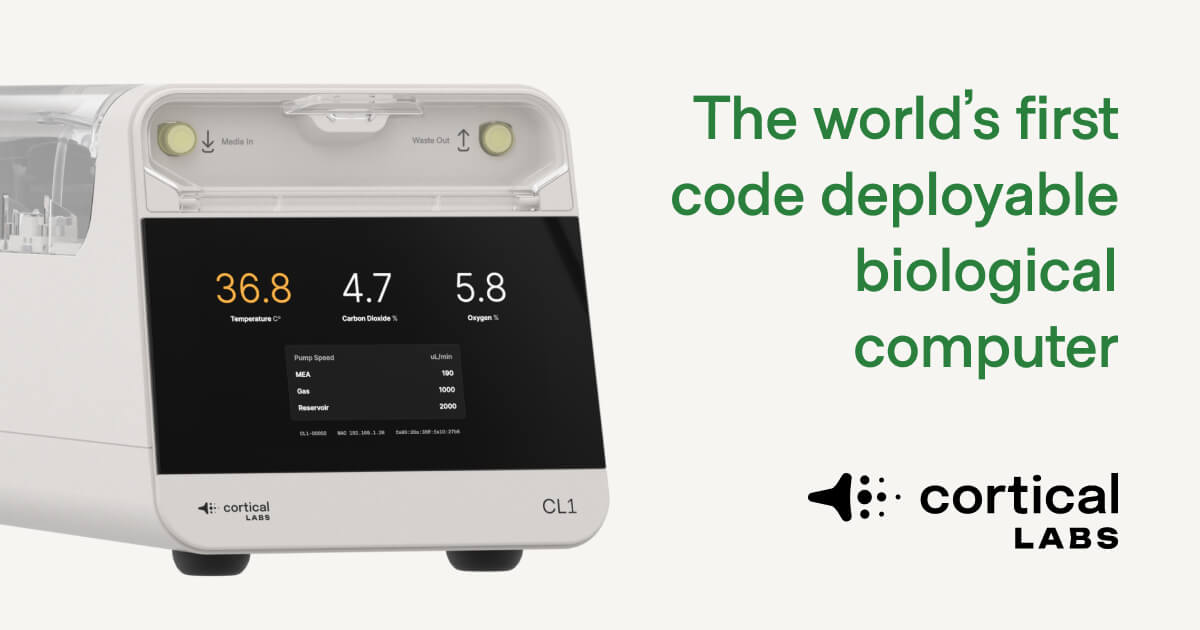
Melbourne-based Cortical Labs on September 23 unveiled Cortical Cloud, a hosted fleet of its neuron-powered CL1 biological computers accessible through a Python SDK. The service opens lab-grown human neural networks to any researcher with an API key, in what the company frames as the first commercial "wetware as a service."
What Cortical Cloud Delivers
Cortical Cloud connects developers to CL1 nodes housing hundreds of thousands of lab-grown human neurons cultured on multi-electrode arrays. Each node runs for roughly six months with integrated life support, closed-loop recording and bi-directional stimulation. Users submit tasks over the Python SDK and receive neuronal responses in real time.
Where CL1 Fits In The Physical-AI Stack
CL1 debuted commercially in 2024 as the successor to Cortical Labs' DishBrain experiment, in which cultured neurons learned to play Pong. The company positions the platform as a substrate for research into biology-inspired intelligence, adaptive control, and energy-efficient computation — territory that pure-silicon foundation models have struggled to occupy at reasonable power budgets.
Access And Availability
Cortical Cloud is open through a signup on corticallabs.com. Pricing is quoted per node-hour and includes device provisioning, culture maintenance and telemetry. The company's Melbourne headquarters retains a small physical lab for customers wanting to lease dedicated CL1 hardware on-site.
Related coverage: Anthropic's Claude autonomously discovers a CRISPR-like enzyme system, Novo Nordisk signs Anthropic for drug discovery, and Orbis Medicines' $1.4B Novo Nordisk deal.
Reporting based on coverage from Cortical Labs, WIRED and industry announcements published September 23, 2026.