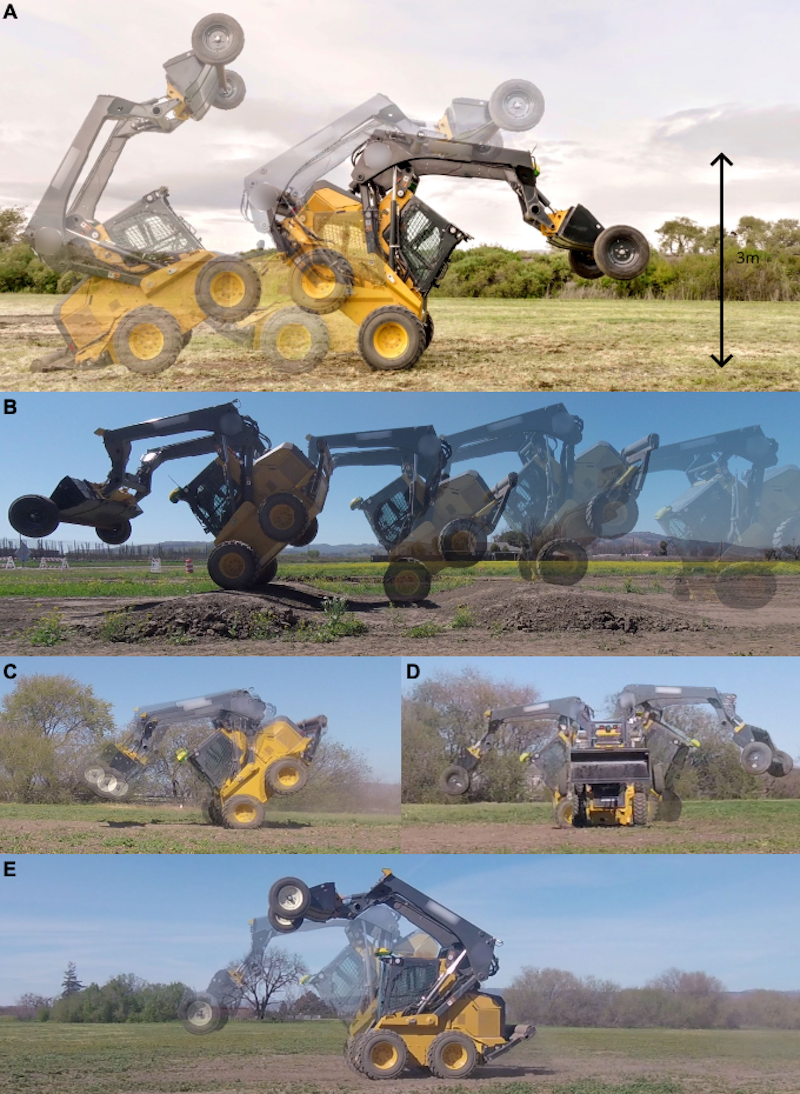
Researchers from ETH Zurich, working with Gravis Robotics, Blue River Technology and Intel, have trained a 5-metric-ton John Deere 332G skid-steer loader to balance on its two front wheels, spin in place, and set itself back down safely. The work, published in Science Robotics on November 26 under the title "Heavy metal acrobatics: Learning dynamic control for skid-steer loaders," treats a heavy construction machine less like a vehicle and more like a robot that happens to weigh five tons.
How does a 5-ton loader balance on two wheels?
The team used reinforcement learning trained entirely in simulation, pairing it with a neural network that predicts how the machine's hydraulic actuators will respond to commands. Hydraulics are notoriously difficult to model precisely because of fluid compressibility and response lag, which is part of why this kind of dynamic control has been rare on construction equipment. Once trained, the resulting controller ran on the physical loader using a standard laptop, with no GPU required for onboard computation.
In testing, the loader balanced on two wheels while crossing terrain with bumps and dips up to 75 centimeters tall, spun in place while balanced, and controlled its angular velocity up to plus or minus 4 radians per second before safely lowering itself back onto all four wheels.
Why train a construction vehicle to do acrobatics at all?
The practical value isn't showmanship. Skid-steer loaders already pivot and maneuver in tight job sites, and a controller that understands the machine's dynamic limits, rather than just its static ones, could let future autonomous loaders navigate uneven terrain, recover from near-tips, or reposition faster in confined spaces without a human operator's intuition. The researchers frame single-skill training like this as a prerequisite for longer, more complex autonomous tasks later.
How did it compare to traditional control methods?
The paper directly compares the reinforcement-learning approach against conventional model predictive control. Reinforcement learning succeeded at transitioning the loader from four wheels to two and executing soft landings in situations where model predictive control failed outright. Conventional control did show an edge in one area: less oscillation during higher-speed spins. That split result suggests the two approaches may end up complementing each other in future autonomous heavy-equipment systems rather than one fully replacing the other.
What does this mean for autonomous construction equipment?
Blue River Technology and Intel's involvement signals interest beyond pure academic robotics, into companies with stakes in agricultural and edge-computing hardware that could run these controllers in the field. Construction and mining already have autonomous haul trucks and excavators in commercial use, but most rely on predictable, scripted maneuvers. Teaching dynamic, recoverable behaviors, like balancing through an obstacle instead of just avoiding it, points toward autonomous equipment that can handle messier, less-prepared job sites.
Source: Robotics and Automation News