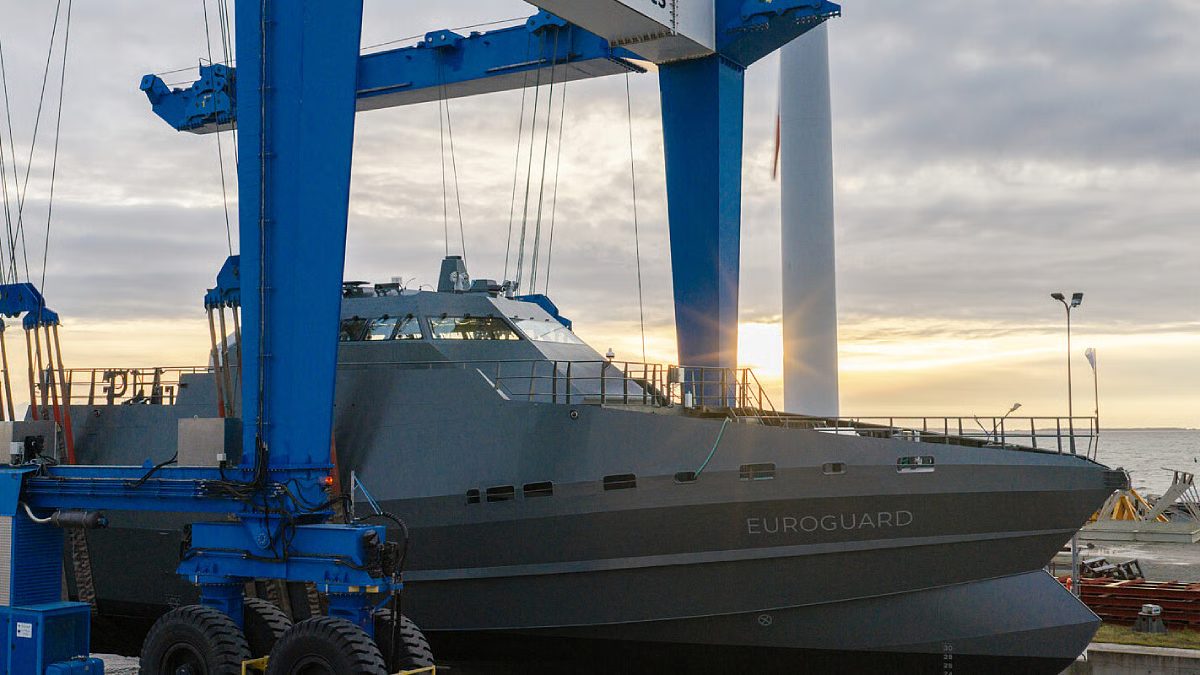
Baltic Workboats launched the Euroguard demonstrator at its shipyard in Nasva, Estonia, on November 19, 2026, putting a 45-meter semi-autonomous naval vessel prototype in the water for the first time. The vessel, backed by the European Defence Fund and built by a consortium of 27 companies from 10 countries including Thales, Leonardo, Naval Group, Navantia and Kongsberg, is designed to carry interchangeable mission modules for mine warfare, maritime surveillance, seabed protection and search and rescue, according to Baird Maritime.
The prototype can reach a minimum speed of 20 knots, carries a range of roughly 2,000 nautical miles and is built for 10 days of endurance at sea. Its keel was laid on May 27, 2025, and the program is scheduled to conclude by November 30, 2027, after outfitting, integration and sea trials with the Estonian Navy next year.
Why a Modular Hull Matters More Than a New Weapon
Euroguard's significance lies in its mission-module design rather than any single capability. Instead of building separate hulls for mine hunting, surveillance and crewless operations, the consortium is betting that European navies need one platform that swaps payloads depending on the mission — a model that mirrors how uncrewed surface vessels have evolved in US and Asian defense programs, but applied at a scale meant for production across multiple EU states rather than a single national fleet.
That multinational structure is itself the point. The European Defence Fund financed Euroguard specifically to pool defense-industrial capacity across smaller and larger EU shipbuilders, reducing reliance on any single country's naval yards. With 27 companies involved, the program also spreads manufacturing know-how for autonomous naval systems across the bloc, a priority that has gained urgency as European navies seek to field uncrewed assets without depending entirely on US or Israeli suppliers.
Part of a Broader European Push Into Uncrewed Naval Assets
Euroguard arrives weeks after the UK Royal Navy stood up its first autonomous surface vessel squadron at Portsmouth, and as Naval Group separately unveiled its 37-meter Seaquest M medium uncrewed surface vessel ahead of Euronaval. Together, these efforts signal that European navies are moving uncrewed platforms from experimental programs into formally funded, multi-year procurement tracks.
Compared with Hyundai Heavy Industries and Anduril's 600-tonne Alpha autonomous surface vessel unveiled in South Korea, Euroguard is smaller and semi-autonomous rather than fully crewless, reflecting Europe's more incremental approach to naval autonomy. Sea trials in 2027 will determine whether the modular concept holds up operationally, but the launch itself marks one of the largest multinational naval robotics collaborations funded by the EU to date, and a template other European defense programs may look to replicate for land and air systems.