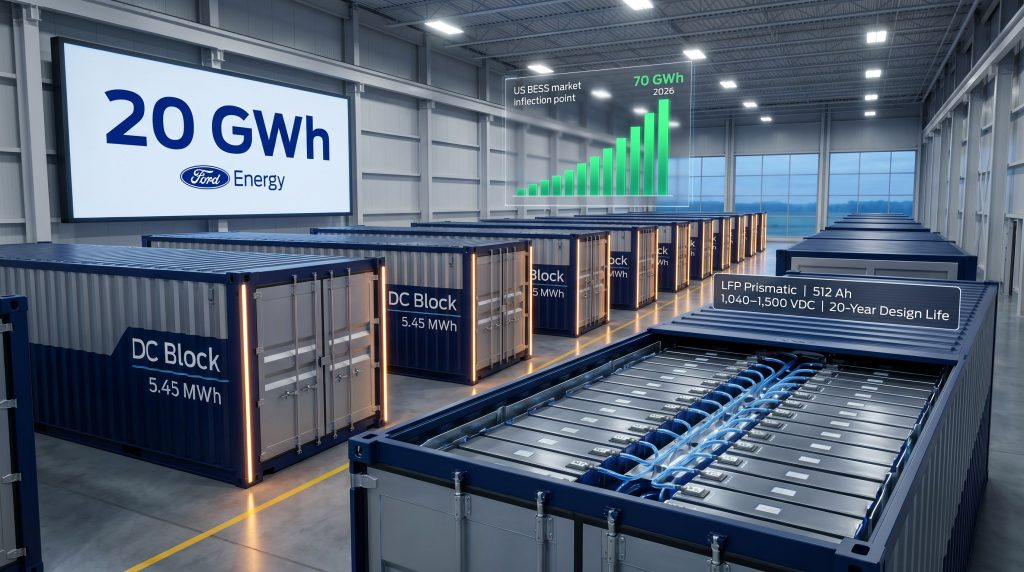
Ford Motor Company has officially launched Ford Energy, a wholly owned subsidiary that will manufacture U.S.-assembled battery energy storage systems for utilities, AI data centers and large industrial customers from a repurposed Kentucky gigafactory.

Ford said the new unit will produce up to 20 gigawatt-hours of grid-scale storage annually, with first customer deliveries scheduled for late 2027. The flagship product, the Ford Energy DC Block, is a standardized 20-foot containerized system built around 512 amp-hour LFP prismatic cells.
Why Ford is pivoting
The automaker invested about $2 billion to set up Ford Energy as part of a broader response to a $19.5 billion 2025 loss in its EV business. Repurposing battery capacity originally earmarked for passenger vehicles into stationary storage moves Ford into a market where AI data center load is driving record demand for fast-deployed gigawatt-scale storage.
EDF anchor customer
Days after the May 11 launch, Ford signed a gigawatt-scale BESS supply agreement with French utility EDF for the North American market, locking in one of Europe's largest power producers as an anchor customer ahead of 2027 deliveries. The deal is a vote of confidence in U.S. battery content rules and accelerates the build-out of Ford Energy's order book.
Market positioning
Ford joins a growing list of U.S. industrial firms — including Meta's deal with Noon Energy and Pattern Energy's SunZia project — racing to feed AI infrastructure demand with domestic energy and storage capacity. The repurposed Kentucky plant gives Ford a faster path to scale than greenfield competitors.
Outlook
If Ford Energy can hit its 20 GWh annual run-rate, it would rank among the largest U.S.-domiciled BESS manufacturers within two years. Execution risk centers on yields at a repurposed line and competition from incumbents like Tesla, Fluence and Wartsila — but with EDF already on the books, Ford has effectively underwritten its first year of output.
Reporting based on coverage from Electrek, Energy Storage News and ESS News.