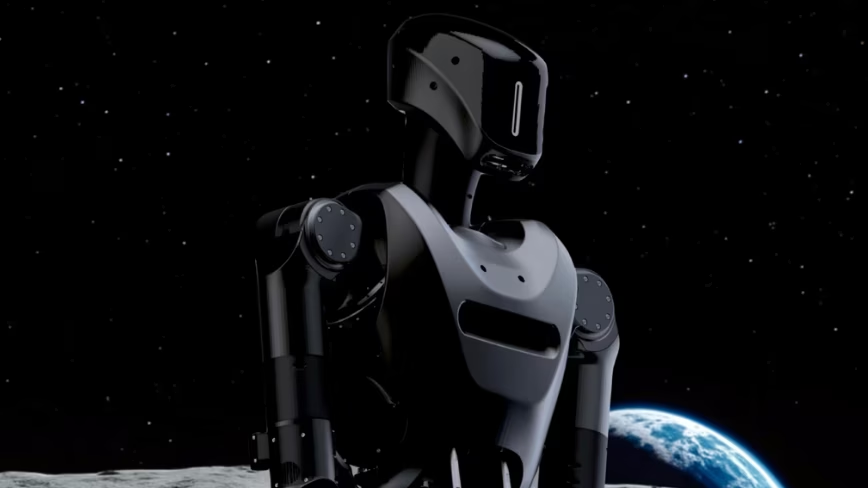
San Francisco startup Foundation Future Industries has confirmed that two of its Phantom MK-1 humanoid robots were sent to Ukraine earlier this year for logistics and reconnaissance trials, in what the company calls the first known deployment of humanoid robots in an active combat theatre. CEO Sankaet Pathak detailed the trials in interviews published on May 30, 2026, alongside disclosures that the company holds roughly $24 million in U.S. Army, Navy and Air Force research contracts and that Eric Trump has joined as chief strategy adviser.
Phantom MK-1 carries supplies under fire
Foundation says the Phantom MK-1, a bipedal humanoid roughly the size of an adult, can carry around 44 pounds and was tested with Ukrainian officials on supply pickups in areas considered too dangerous for soldiers. The robot currently lacks waterproofing and the battery life needed for sustained autonomous operation, and Foundation plans to ship upgraded Phantom 2 units to Ukraine later this year with roughly double the payload capacity.
$24M in Pentagon contracts and a Trump connection
The company, founded in 2024, has secured feasibility contracts across the Army, Navy and Air Force covering inspection, logistics and weapons handling. Eric Trump, the second son of the sitting U.S. president, joined Foundation as chief strategy adviser after first investing in the company. Senator Elizabeth Warren publicly criticised the arrangement as "corruption in plain sight," while a Foundation spokesperson said Trump had been an investor before becoming an adviser.
From Synapse to a humanoid war robot
CEO Sankaet Pathak previously led Synapse, a fintech platform that filed for bankruptcy in 2024. Foundation has also drawn scrutiny after suggesting close ties to General Motors, claims GM has rejected. Pathak now says Foundation will scale production to thousands of units this year and aims to put humanoid robots on U.S. front lines within 12 to 18 months, arguing that bipedal designs can navigate stairwells, basements and narrow corridors built for humans.
A crowded Pentagon humanoid race
Foundation is one of several humanoid and counter-drone startups racing for Pentagon contracts amid a sharp ramp in autonomous-systems spending. The U.S. Army recently awarded Anduril a $5B Series H boost and handed Perennial Autonomy a $500M counter-drone deal, while the Defense Department is considering equity stakes in Neros, Unusual Machines and PDW. Pentagon AI use has also jumped 1,775% as DoD orders 200,000 drones, underscoring how quickly autonomous platforms are moving into U.S. doctrine.
Ethical and operational questions
Some weaponised Phantom use cases will retain a human in the decision loop, Pathak said, while in certain time-critical scenarios the robots will be expected to make fully autonomous choices. Independent analysts remain split: CSIS senior fellow Kateryna Bondar argues humanoid forms suit urban combat, while Brookings researcher Melanie Sisson counters that Ukraine has shown the need for cheap, mass-producible systems rather than complex humanoids. Toby Walsh of the University of New South Wales AI Institute said tracked, flying and underwater robots will likely beat humanoids to the battlefield.
Reporting based on coverage from CNBC and TheNextWeb.