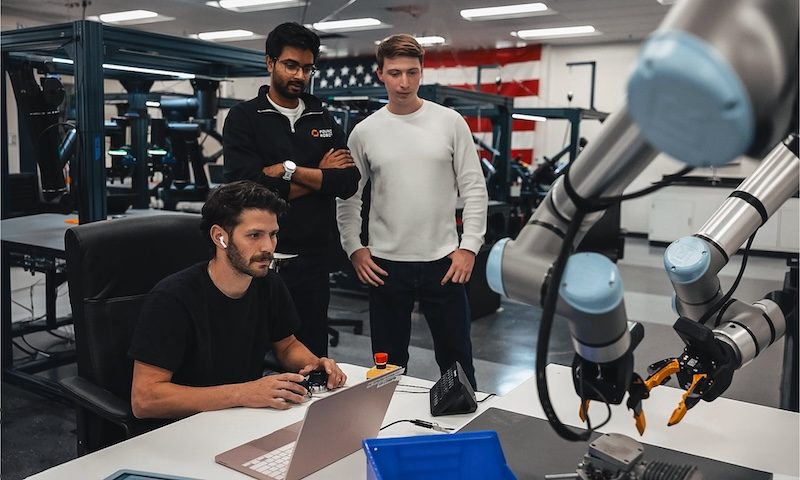
Inside a 130,000-square-foot building in Emeryville, California, robotic cells are reconfigured hour by hour to assemble parts for drones, underwater vehicles, satellites and ground robots, rather than running a single product down one fixed line. The startup behind that facility, Foundry Robotics, announced on October 28 that it closed an oversubscribed $100 million Series A to expand the plant and scale what it calls America's first autonomous factory for complex assembly, according to a Robotics & Automation News report.
The round was led by Marlinspike Partners, with Khosla Ventures, Red Glass Ventures, SE Ventures, Wing VC, Axiom Ventures, Hanabi and Zero Shot Fund also participating. Foundry was co-founded by chief executive Adarsh Kulkarni and Emmanuel Lamacchia, a former Tesla Model Y program manager, and the company says its manufacturing footprint has grown twentyfold over the past year.
Solving a Bottleneck Defense Contractors Can't Build Around
Foundry is targeting a specific choke point: hardware makers, particularly in defense, that can design a product but can't find assembly capacity to build it at volume. Duane Fotheringham of HII Unmanned Systems, quoted in the announcement, called production capacity "a national constraint on getting unmanned systems to the fleet." The comment reflects a broader concern among defense planners, who have pushed suppliers to shorten the path from prototype to volume production as demand grows for drones and unmanned systems.
Instead of custom lines built for one part number, Foundry pairs AI-controlled robotic cells with human technicians, allowing a design to move into production within weeks rather than the months or years needed to finance a dedicated line. Software called FoundryOS coordinates the robots, tracks production, and feeds assembly data back into the company's AI models so later runs get faster and more consistent than earlier ones.
That is a manufacturing-as-a-service model: Foundry owns and operates the factory itself rather than selling robots or software licenses to other manufacturers, earning revenue on throughput instead of equipment sales. Customers can move from a finished design to production runs without financing their own dedicated line, shifting capital risk onto Foundry rather than the hardware company.
Part of a Bigger Wave of Robotic Manufacturing Capital
The $100 million round lands in a year when robotics startups have pulled in roughly $18.8 billion globally, up from about $15 billion in all of 2025, according to Crunchbase data on venture funding trends. Much of that capital has gone to humanoid and warehouse robot makers; Foundry's bet instead is on owning the factory floor behind defense and industrial hardware, a segment that has drawn less attention but faces acute capacity shortages as buyers push for faster output of drones and ground systems.
Foundry says the new funding will expand its Emeryville facility, accelerate deployment of its AI manufacturing models, and grow its robotics, engineering and factory operations teams. The company has not disclosed current revenue or a timeline for additional sites, but its pitch to investors rests on proving that one factory can be reconfigured fast enough to serve drone makers, satellite builders and ground robot companies without each needing a dedicated production line of its own.