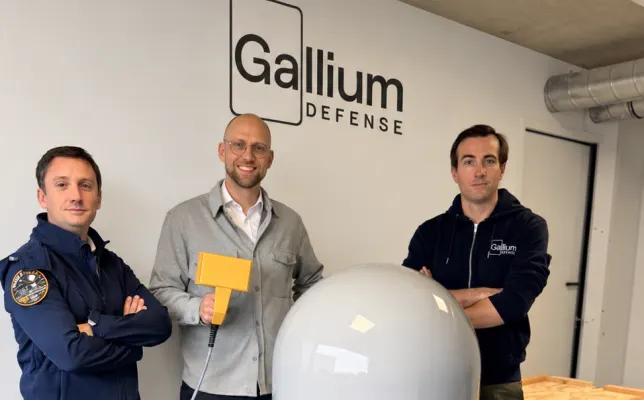
Gallium Defense, a Paris-based startup founded just seven months ago, has raised €7.1 million in seed funding to bring a low-cost drone-detection radar to market. The round was led by Keen Venture Partners and 360 Capital, with Omnes Capital and Polytechnique Ventures also participating, according to FinSMEs.
The company was founded in April 2026 by Eric Fournier, Florian Lemoine and Robin Mandel. Its first product, the GDS-10, is an X-band radar built to spot small drones, including FPV racing-style drones, from up to 10 kilometers away.
What makes this radar different?
Most military-grade counter-drone radars cost between €2 million and €5 million per unit, largely because they run on legacy hardware designed to track aircraft and missiles rather than swarms of cheap quadcopters. Gallium is targeting a price near €500,000, a fraction of the going rate, according to Tech Funding News.
The GDS-10 gets there with a software-defined, AI-native design. Instead of relying on fixed-function radar chips, it processes signals through code that can be updated after a unit ships, the same logic that lets a phone camera improve through software rather than new glass. The unit scans 360 degrees horizontally and 90 degrees vertically, and the company says it can track multiple targets at once, including drone swarms, even in poor weather or under electronic jamming.
Gallium is building two versions of the radar: one aimed at critical-infrastructure operators guarding airports, ports and power plants, and another hardened for armed forces. Field trials are already underway outdoors, and the company plans monthly demonstrations for civilian and military buyers through early 2027.
Why is cheap drone detection suddenly a hot category?
The war in Ukraine turned small, disposable drones into a front-line weapon, and airports, prisons and power utilities worldwide have had their own run-ins with unauthorized drone incursions. Demand for detection has outpaced the ability of legacy defense contractors to supply it at a price smaller buyers can afford.
That gap has pulled in a wave of venture-backed challengers. Gallium's pitch is explicitly about undercutting the France-based incumbents and other European radar makers that dominate NATO procurement lists, positioning itself closer to a budget alternative than a premium competitor. The company says it is already in talks with six potential customers and is targeting roughly €6 million in orders for 2027.
It is a crowded field. Startups and established players alike are racing to pair radar with cameras, radio-frequency sensors and AI-based classification to tell a hobbyist's quadcopter from a hostile FPV drone. Gallium's bet is that software-defined radar, updated like an app rather than replaced like a piece of hardware, will let it iterate faster and cheaper than rivals building on older airframe-detection architectures.
The next test is commercial: Gallium has no revenue yet, and converting demonstration interest into signed contracts by 2027 will determine whether its price advantage translates into market share against better-funded competitors.