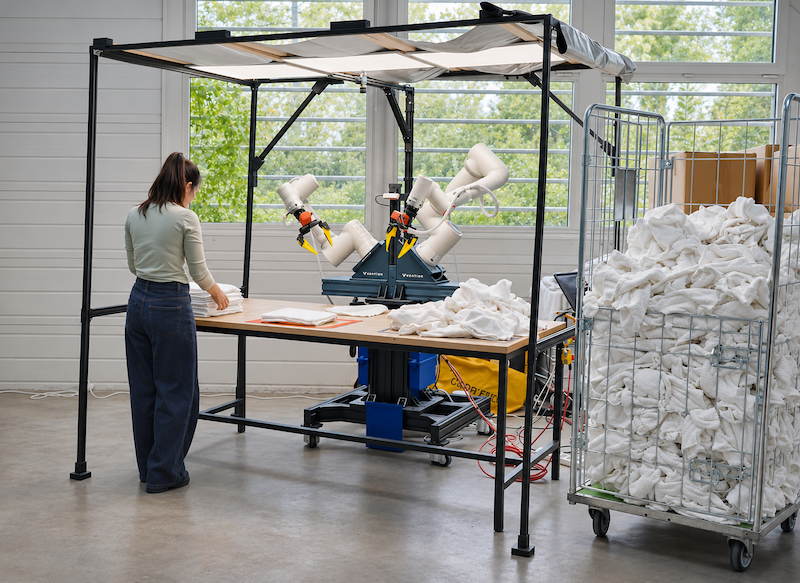
French robotics startup Gobano Robotics says its Gobano Station has reached a 99.5% task success rate folding and inspecting towels at an industrial laundry run by the Henri Wartner Group, a 150-year-old French laundry operator. The system runs autonomously for shifts of up to 18 hours, reaching roughly 68% of a human worker's throughput over that period.
According to Robotics and Automation News, the station handles variation in how towels arrive: different positioning, fabric folds and gripping conditions that would trip up a fixed, pre-programmed pick-and-place routine. When a grasp fails or a towel lands wrong, the system detects the error and restarts the workflow on its own, without a technician intervening.
Reinforcement learning built for messy fabric, not rigid parts
Gobano built the system on what it calls Toutatis, a reinforcement learning engine that combines recorded human demonstrations, task-specific world models, and data gathered from the robot's own operation on the floor. That combination matters because folding fabric is a notoriously hard robotics problem: towels deform, bunch and slide in ways rigid industrial parts never do, which is why most warehouse and factory automation has historically avoided textiles altogether.
Industrial laundries are a plausible entry point for that kind of manipulation because the task repeats constantly and the item being handled, while deformable, is simple and uniform compared to, say, folding assorted clothing. Gobano's figures suggest the approach scales well enough across a long shift that throughput loss from occasional grasp failures stays small, with the company reporting roughly 5% daily throughput gains as the system accumulates more operating experience.
Where this fits in the robotics market
Deformable-object manipulation has drawn increasing investment because it covers a huge swath of manual labor that pick-and-place robots can't touch: laundry, textiles, food handling and packaging all involve materials that bend and shift. Gobano's approach, folding towels specifically rather than general clothing, narrows the problem to something closer to solved, trading generality for a success rate that's commercially usable today.
That's a different bet than humanoid robot makers are placing on general-purpose dexterity, and it echoes other recent moves into narrow, high-repetition manipulation tasks rather than chasing broad versatility. For an industrial laundry operator like Henri Wartner Group, the pitch is straightforward: offload a repetitive, injury-prone task to a machine that runs longer shifts than a person without a meaningful drop in accuracy.
Gobano has not disclosed funding, pricing, or how many units are deployed beyond the Henri Wartner Group site. The company's next test will be whether the Toutatis engine, trained on towels, generalizes to other flat linens like sheets and tablecloths, which would open a much larger slice of the commercial laundry market than towels alone.