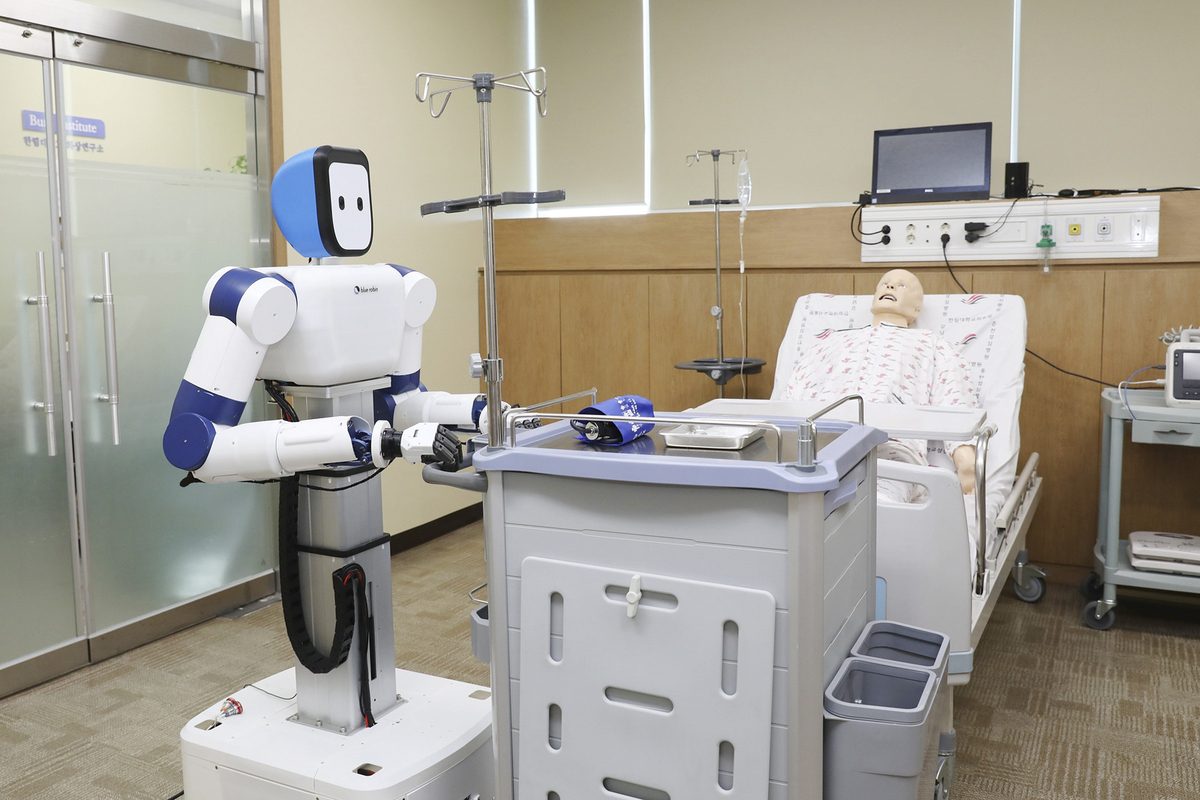
Hallym University Sacred Heart Hospital has started testing a wheeled, humanlike robot built with robotics firm BlueRobin inside a simulated hospital ward, checking whether it can navigate tight corridors and carry out basic delivery tasks. The trial, reported November 20, 2026 by Seoul Economic Daily, took place at the hospital's dedicated Hallym Simulation Center.
What exactly did the robot do?
The prototype combines a wheeled mobile base with a humanlike upper body, and the test focused on practical ward tasks rather than complex manipulation. Engineers evaluated how it moves through narrow corridors, delivers medical supplies and patient gowns, and transports mobile medical equipment within a mock ward environment built to mirror real hospital layouts.
Who is running the project, and why a simulation center?
The work is part of a South Korean Ministry of Trade and Industry robot technology development project that has been running since 2025. Lee Mi-yeon, who heads the hospital's command center, said the test is \"a starting point for identifying what functions are actually needed in the field,\" while Park Sung-ho, head of the hospital's H-CORE unit, said the plan is to grow the simulation center into \"a venue for convergence training\" between robots and hospital staff. Running trials in a controlled mock ward lets the team fail safely, correcting navigation and task errors before ever putting a robot near real patients.
Why does a wheeled humanoid matter more than a pure delivery cart?
Hospitals already use plenty of wheeled delivery robots, but most are boxy carts with no ability to interact physically with people or environments built for human hands. A humanlike upper body opens the door to tasks current hospital robots can't do well, handing an item directly to a nurse, operating a drawer, or assisting with light physical tasks, without requiring a full redesign of ward infrastructure. That's a different bet than Boston Dynamics' Atlas or Agility's Digit, which target industrial floors; BlueRobin and Hallym are explicitly aiming the platform at hospital and home environments where legged mobility matters less than dexterous upper-body work on a stable base.
What's the timeline from here?
The hospital says it will fold the test data into refined hardware and control-software specifications before deciding on further development. No date has been set for moving the robot out of the simulation center and into a live ward with real patients and staff, and the companies have not disclosed a commercial timeline or cost target for the platform.