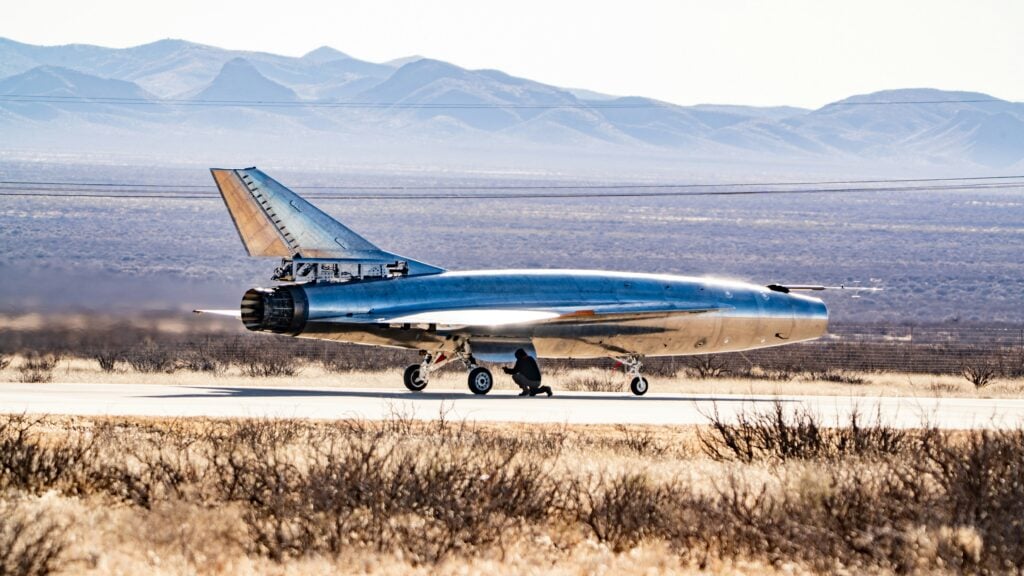
Atlanta-based aerospace startup Hermeus has won a $159 million contract modification from the U.S. Defense Innovation Unit (DIU), raising the total ceiling of its Quarterhorse program to $219 million and turning what began as a hypersonic technology demonstrator into a near-term, payload-carrying high-speed drone candidate. The award, disclosed on May 28, 2026, funds a fresh series of flight tests in 2026 and 2027 aimed at releasing payloads at speeds "up to and including Mach 3," CEO Zach Shore told Breaking Defense.
From Test Article to "Unmanned F-16"
Hermeus has been iteratively flying its Quarterhorse vehicle: the Mk 1 cleared subsonic flight last year, and the larger Mk 2.1 recently completed a supersonic flight test. The new DIU funding underwrites the next stage of that roadmap, with Mk 2.2 slated to fly this year and Mk 2.3 planned for the first half of 2027. "You're looking at something that's effectively an unmanned F-16," Shore said. "When we're done with the series, you'll have an unmanned F-16 that could hit Mach 3."
Payload Release Becomes the Mission
The DIU money is specifically tied to demonstrating that Quarterhorse can carry and release externally mounted payloads at very high speeds. Shore declined to disclose specific payload types but said the test plan now formally brings both the Air Force and Navy into the program as DIU partners. Air Force Maj. Gen. Joseph Kunkel, DIU's military deputy, said in the Hermeus release that if the aircraft can be mass produced, it "becomes a game-changing warfighting capability, where we use it as a weapon instead of a test platform."
Engine Path: F100 Now, Chimera Later
The Mk 2 series uses the Pratt & Whitney F100 engine, which Hermeus can refurbish from Air Force inventory. Upcoming flight tests will validate a new inlet, a Hermeus-developed precooler, and a steel airframe designed to sustain higher Mach numbers. For its longer-term hypersonic ambitions, the company is developing a turbine-based combined-cycle engine called Chimera, which switches from a gas turbine at lower speeds to a ramjet beyond Mach 3 and would power a follow-on platform Hermeus refers to as Darkhorse.
Why It Matters for the High-Speed Drone Race
The Quarterhorse extension is one of the largest single-program awards DIU has made and signals that the Pentagon increasingly sees commercial-style, iteratively flown high-speed unmanned platforms as cheaper alternatives to bespoke programs. Shore said the aircraft would be priced "certainly less expensive than a manned fighter and highly competitive to a CCA," referring to Collaborative Combat Aircraft wingmen. He pegged early-stage output at 12 to 15 aircraft per year. The award also lands in a week dense with defense-tech capital activity, including Anduril's $5 billion Series H at a $61 billion valuation and a new round of Pentagon equity-stake talks with American drone manufacturers.
What Comes Next
Hermeus said it does not yet have dedicated manufacturing facilities and will focus its next equity round on building out production capacity. Once the Mk 2 series finishes its DIU milestones, Shore said the company expects to begin transitioning the platform into service alongside one of the military branches, while continuing development of the Mach 5-plus Darkhorse line.
Reporting based on coverage from Breaking Defense, Defense Daily, Air & Space Forces Magazine, and Hermeus.