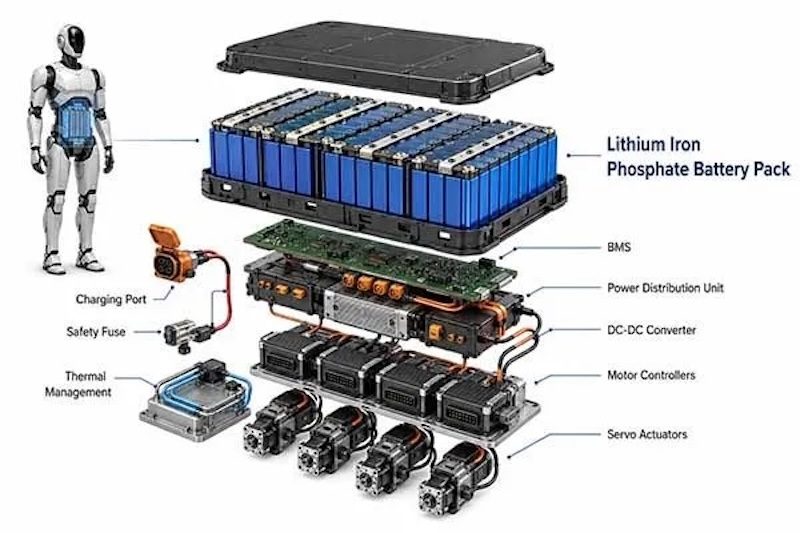
Batteries built specifically for humanoid robots are on track to become a market worth more than $850 million by 2037, growing at a compound annual rate of 34.2% over the next decade, according to a new forecast from technology research firm IDTechEx. The firm projects total battery demand for humanoid robots will reach 10.5 gigawatt-hours a year by that point, driven in part by the practice of swapping depleted battery packs for charged ones rather than waiting for a robot to recharge in place, according to coverage of the report.
The forecast lands at a moment when battery life, not processing power or dexterity, has become one of the more visible bottlenecks slowing humanoid robots from factory pilots to full shifts on a production line.
Why can't humanoid robots just use EV battery technology?
Electric vehicles optimize mostly for range and cost per mile. Humanoid robots optimize for a narrower, more specific problem: how many hours of actual work they can squeeze from a battery that also has to fit inside a torso or backpack without adding so much weight that it throws off the robot's balance. Agility Robotics' Digit 5, for example, runs for about 90 minutes per charge, but pairs that with a fast-charging system from battery maker Nyobolt that can refill the pack in roughly 9 minutes, letting a robot plausibly string together more than 20 hours of working time across a day through repeated short charging breaks rather than one long overnight charge.
That tradeoff between runtime, charge speed and weight is why IDTechEx expects demand for spare battery packs to grow faster than the number of robots deployed. A warehouse or factory running robots in shifts needs extra packs charging on the sidelines to swap in, which multiplies battery demand well beyond a simple one-battery-per-robot count.
What replaces today's lithium-ion packs?
Most humanoid robots currently run on nickel-manganese-cobalt (NMC) lithium-ion cells, the same broad chemistry family used in consumer electronics and EVs, in mid-, high- and ultra-high-nickel variants chosen for their balance of energy density and cost. IDTechEx expects solid-state batteries, which replace the liquid electrolyte inside a cell with a solid material, to begin reaching mass production toward the end of the 2020s. Removing the flammable liquid electrolyte matters more for robots than for cars, because humanoid robots are designed to work in close physical proximity to people on a factory floor, and a safer cell chemistry lowers the odds of a thermal event causing harm nearby. Solid-state cells can also pack in more energy per kilogram, with the report pointing to figures above 400 to 500 Wh/kg versus current lithium-ion packs, letting a robot carry the same runtime in a lighter, smaller battery.
Further out, IDTechEx points to lithium-sulfur chemistry reaching commercial viability in the early 2030s. Lithium-sulfur cells are cheaper to produce than lithium-ion because sulfur is abundant, but the report notes they still suffer from shorter cycle life, meaning they degrade faster over repeated charge cycles, a tradeoff that may suit robots replaced or refurbished every few years more than ones expected to run for a decade.
The report cautions that battery specs alone will not determine whether a robot hits its productivity targets. As the research notes, "whether it delivers the intended productivity will depend on the complete operating cycle, including travel to the charger, maintenance and task delays," meaning a robot with an impressive runtime figure can still lose hours each day walking back and forth to its charging dock.