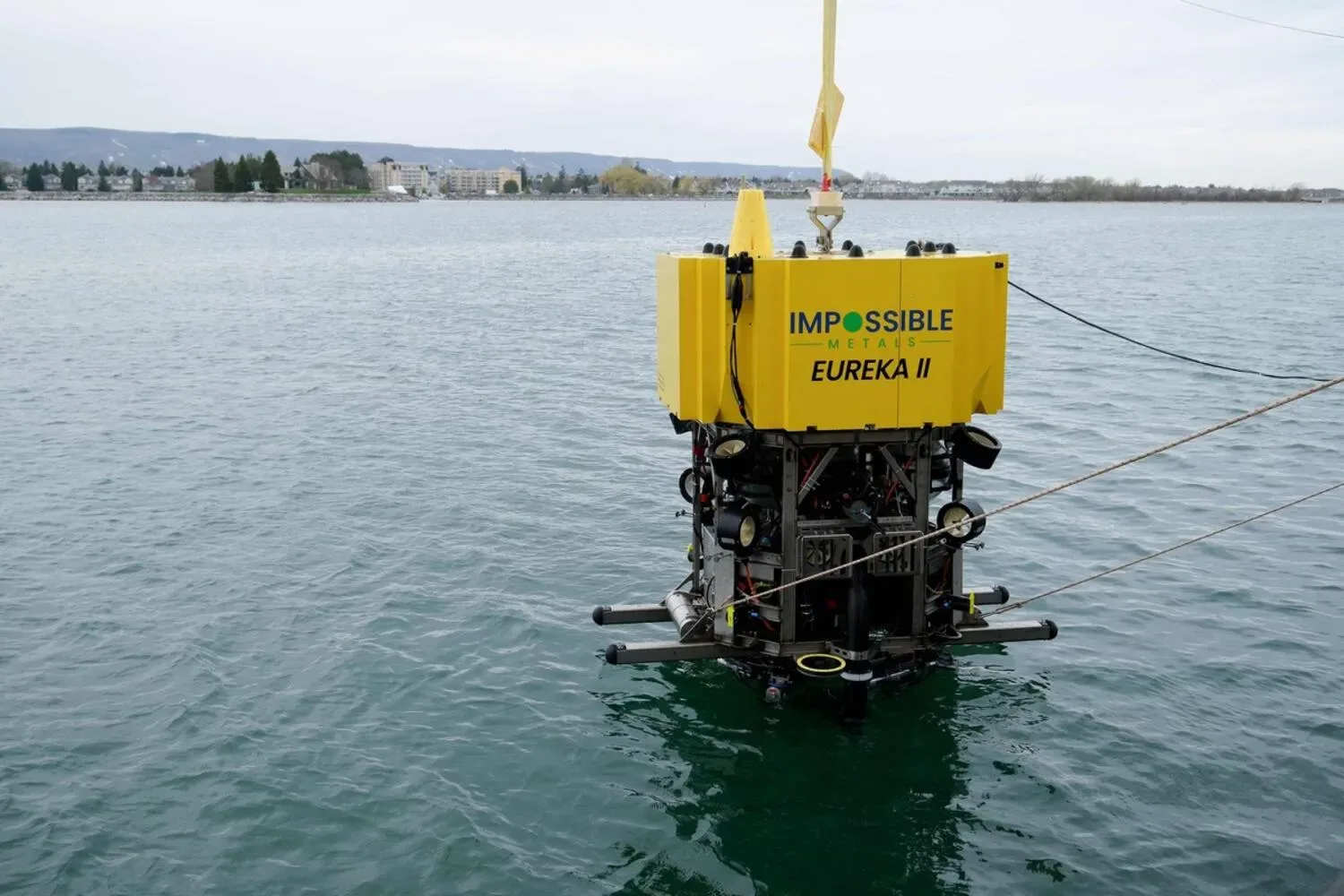
Deep-sea mining startup Impossible Metals says it has successfully tested an autonomous, AI-guided robot that retrieved polymetallic nodules from more than 4,000 meters below the surface of the Pacific Ocean, according to a company announcement covered by Asharq Al-Awsat on November 11, 2026. The test, conducted during a scientific expedition in September, saw the robot descend to the seabed, collect roughly 450 grams of nodules using a mechanical claw, and return to the surface.
The California-based, Y Combinator-backed company says the robot's AI vision system is designed to identify and avoid marine life while selectively picking up nodules rich in nickel, copper, cobalt and manganese — metals used in batteries and electronics. Impossible Metals closed a Series A round earlier in 2026 valued near $25 million, with the company itself valued at roughly $110 million. The round added a notable new backer: the family of FedEx founder Fred Smith, which the company says has become its second-largest shareholder through a substantial investment.
How does the robot avoid harming the seafloor?
Deep-sea mining has drawn sustained criticism from marine scientists and environmental groups, largely because conventional methods drag heavy collection equipment across the seabed, disturbing sediment and the organisms living in it. Impossible Metals' pitch is that its robot works more like a precision picker than a plow: an onboard AI system scans the seafloor, identifies individual nodules, and uses a claw to lift them one at a time while steering around visible marine life.
Richard Smith, a Fortune 500 executive tied to the Smith family investment, described the approach to the outlet as a system that "goes down there and plucks these nodules off the seabed floor without disturbing the environment." Independent verification of that environmental claim has not yet been published, and the September test retrieved only a small sample rather than commercial volumes.
What has to happen before this scales up?
Impossible Metals still needs regulatory clearance before it can mine at commercial scale. The company says it is pursuing approval either from the International Seabed Authority, the United Nations-affiliated body that governs mining in international waters, or directly from the United States government for operations in domestic waters — a path some seabed mining firms have pursued as ISA rulemaking has dragged on for years.
The company says the September results will feed directly into the design of a larger version of the robot capable of operating at commercial scale. That puts Impossible Metals in a small, young field of deep-sea robotics companies — alongside firms like The Metals Company — racing to prove autonomous collection technology works at depth before a broader regulatory framework for ocean-floor mining is settled. For now, 450 grams is a long way from a commercial operation, but it is the kind of concrete field data point that investors and regulators will use to judge whether robotic claws are a viable alternative to dredging.