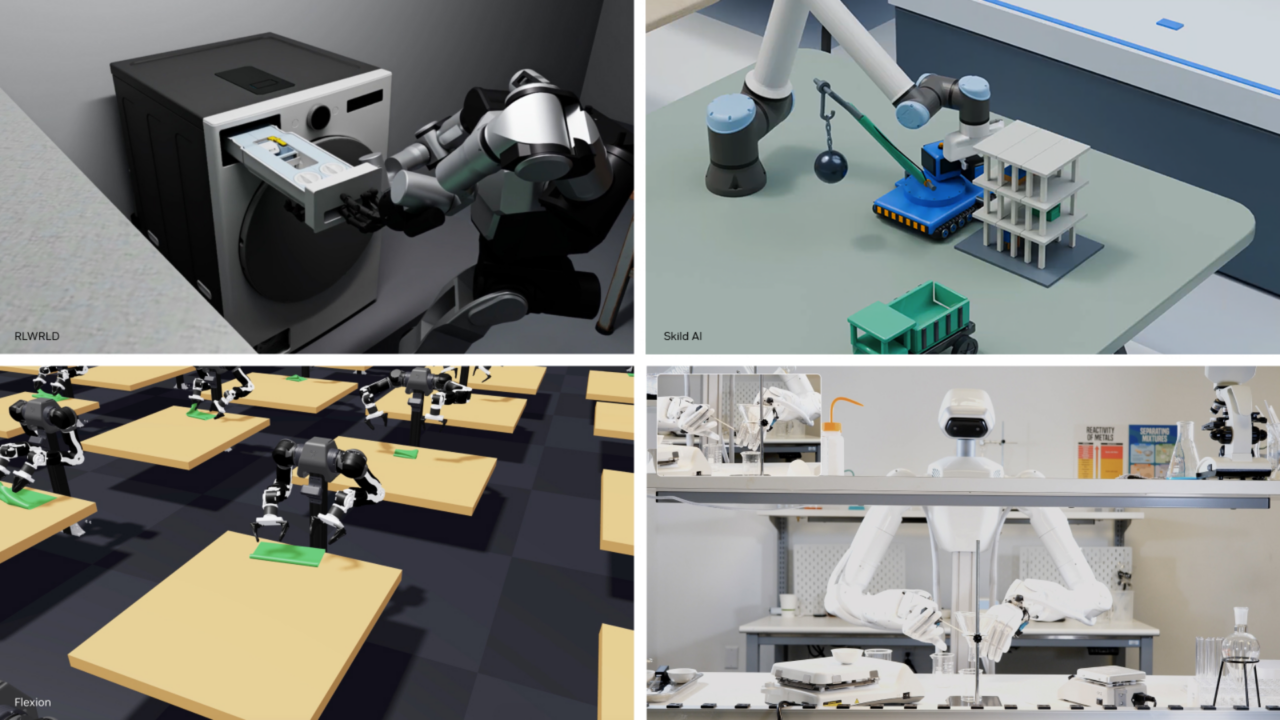
Teaching a robot a new task usually means hundreds of repetitive demonstrations and hours of retraining. Nvidia says it has cut that down to minutes. At the Conference on Robot Learning (CoRL) in Austin on November 9, 2026, the company introduced GR00T 2, an updated open robot foundation model, alongside Isaac Lab 3.0, a simulation and training toolkit built to feed it.
GR00T 2 is trained on a mix of robot and human data, anchored by 100,000 hours of Nvidia's own open-source egocentric human video. Fed a camera view, a robot's current state, and a written instruction, the model generates an expected future view alongside the next sequence of actions, and a single pretrained checkpoint works across parallel-gripper arms, dexterous hands and full humanoid bodies.
What the Benchmarks Actually Show
The headline numbers are built around how little task-specific data the model needs. Across 50 evaluation tasks, GR00T 2 completed 40 of them at least once with zero task-specific demonstrations at all. Give it one demonstration per task and average success climbs to 71%; give it five, which amounts to under three minutes of robot data per task, and success reaches 95%. Nvidia says adapting the model to a new task after that data collection takes roughly a 30-minute fine-tune on a single RTX 5090.
Isaac Lab 3.0 is the training environment behind those numbers. It lets researchers switch between Nvidia's PhysX and the newer Newton physics solver, and in vision-based dexterous manipulation benchmarks, Isaac Lab 3.0 running on Newton delivered up to 2.5 times the training throughput of the previous Isaac Lab 2.3 release on PhysX. A new reinforcement post-training library lets teams apply further fine-tuning directly to foundation models like GR00T 2 rather than training from scratch.
Who's Already Testing It
Nvidia named three companies piloting the stack: Nexuni for robotic laundry handling, Foxconn for server-manufacturing factory automation, and Siemens across unspecified industrial use cases. That trio signals Nvidia's ambition isn't limited to humanoid showcases — it's chasing the much larger, messier world of contract manufacturing and logistics, where task variety is high and retraining costs have historically been the blocker to automation.
The move keeps Nvidia's robotics stack at the center of a crowded field that includes Google DeepMind's Gemini Robotics, Physical Intelligence's pi models and a wave of Chinese foundation-model efforts from companies like AgiBot and RoboScience. Nvidia's bet is that owning both the simulation layer (Isaac Lab) and the foundation model (GR00T) gives it an edge other labs can't easily replicate, since faster simulated training directly feeds better real-world sample efficiency.
Nvidia says GR00T 2's code will be released in December 2026, following the pattern it set with the original GR00T N1 model, according to Nvidia.