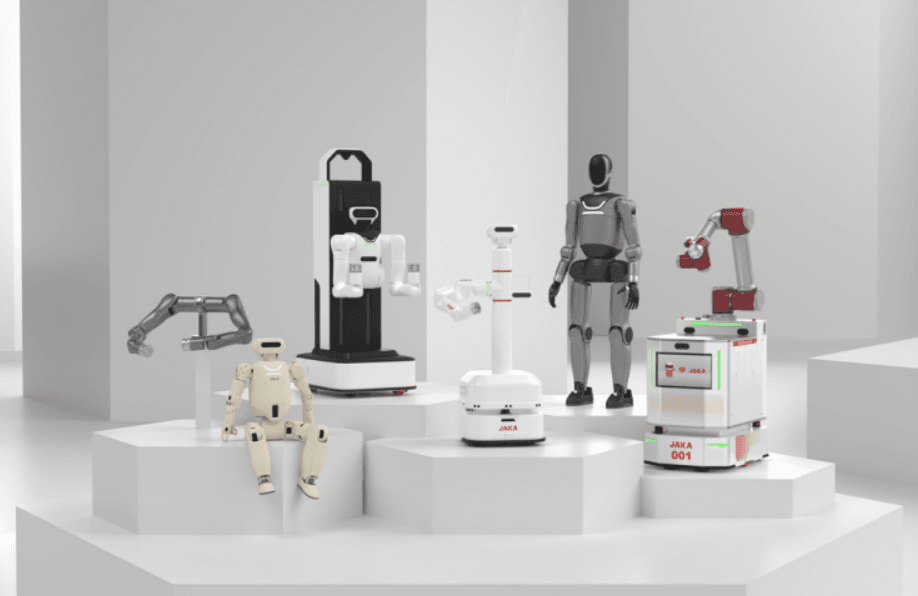
Shanghai-based JAKA Robotics has unveiled JAKA Pi, a compact humanoid robot just 1.22 meters tall and 42 kilograms in weight, positioning the platform as an affordable on-ramp for embodied AI research, vocational training and light-duty service work.
A Smaller Humanoid Built For Real Environments
JAKA Pi measures 1220 by 420 by 220 millimeters, making it one of the most compact full-body humanoids on the market. The robot has 27 degrees of freedom and uses integrated joint modules that JAKA says are 15-27 percent smaller in diameter than the company's previous generation. Each knee delivers 120 Nm of torque for stable locomotion, while each arm carries a 3 kg payload — enough for typical lab manipulation, demonstration and light pick-and-place tasks.
Two-Brain Architecture For Embodied AI
JAKA Pi runs a dual-controller stack that separates high-level cognition from low-level motion. The cerebrum handles language understanding, perception and task planning, while a real-time cerebellum drives the joints over an EtherCAT bus at millisecond-level latency. JAKA says the split lets the robot complete the full loop from understanding a verbal command to planning and executing physical actions with smooth coordination, with the determinism needed for safe operation around people.
Education, Service And Companionship
JAKA is targeting the robot primarily at universities, vocational schools, tech exhibitions and elderly companionship pilots, rather than fully autonomous industrial workcells. In AI labs the platform is pitched as a complete embodied intelligence teaching system that supports secondary development and interdisciplinary experiments. In commercial settings it can act as a tour guide or staffed-event greeter, and in eldercare pilots as a basic companion. The launch builds on JAKA's 2025 brand upgrade from collaborative robot vendor to general-purpose intelligent robotics company, complementing the heavier full-size humanoids on display from peers such as NVIDIA and Unitree, VinDynamics and Japan's Atom.
Reporting based on coverage from Pandaily and Interesting Engineering.