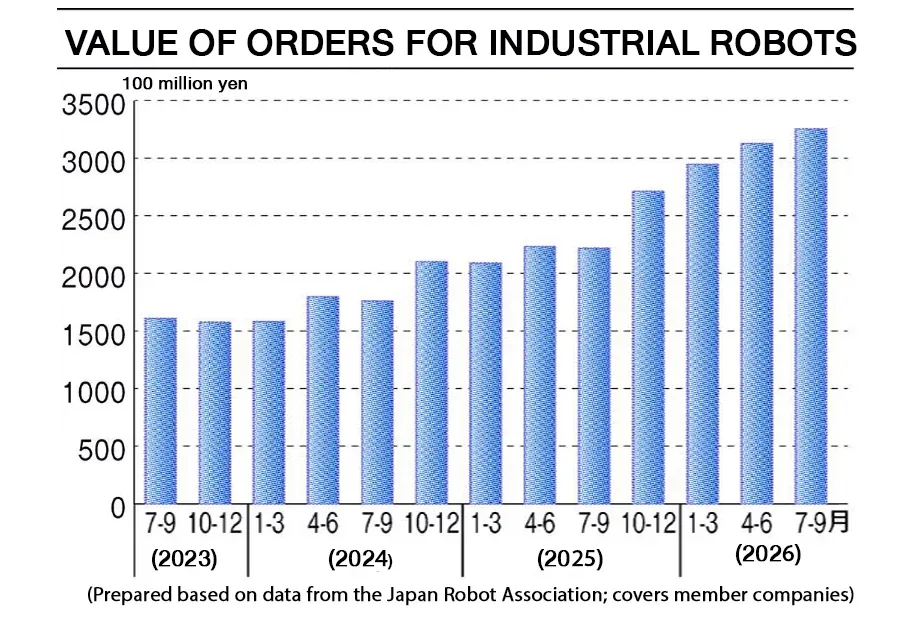
Industrial robot orders in Japan jumped 46.6% year-on-year to a record ¥325.4 billion ($2.1 billion) in the third quarter of 2026, the Japan Robot Association reported on November 22, marking the ninth consecutive quarter of order growth and the fourth straight quarterly record for the industry.
Unit orders climbed 36.1% to 67,003 machines between July and September, according to data cited by MREPORT. Production value rose 26.2% to ¥261.5 billion, an eighth straight quarter of growth, while total shipment value increased 22.1% to ¥264.7 billion. Domestic shipments climbed 16.3% to ¥48.2 billion — meaning roughly 82% of everything Japanese factories shipped in the quarter went overseas, a reminder of how export-dependent the industry remains.
Electronics and welding carry the quarter
Electronic component mounting machines did the heaviest lifting. Exports of that category to China and Thailand pushed its value to ¥103.3 billion, up 41.6% year-on-year, as chipmakers and battery assemblers across Asia keep adding capacity for AI-related manufacturing. Welding robots, which had contracted for two straight quarters, returned to growth with a 2.2% increase. Most notably, automotive-sector orders rose for the first time in six to seven quarters — up 15.5% by unit count and 5.3% by value — a sign Japan's carmakers may finally be restarting capital spending after a long pause tied to EV-transition uncertainty.
JARA credited the strength to "global demand for automation, AI-related investments, and various policies," language the trade body has repeated through most of 2026 as data centers, chipmakers and battery plants race to add capacity.
Why a Japanese order book matters globally
Japan's robot makers — Fanuc, Yaskawa Electric, Kawasaki Heavy Industries and Mitsubishi Electric chief among them — account for a large share of the world's industrial robot shipments, so JARA's quarterly figures act as an early read on global factory capital spending. Nine consecutive quarters of growth is a far longer run than the brief 2023 rebound, when post-pandemic restocking drove a spike that collapsed within two quarters.
The data also complicates a popular narrative in robotics circles: that humanoid and general-purpose robots are starting to cannibalize demand for fixed-arm industrial machines. Instead, JARA's numbers show both categories expanding side by side. The same electronics and automotive customers buying more conventional placement and welding robots this quarter are, in many cases, also running humanoid pilots for material handling, kitting and inspection work that doesn't fit a dedicated fixture.
Rival supply chains in South Korea, Germany and China are watching the same demand signals. Chinese domestic robot makers have gained share in their home market this year, but Japan's export growth suggests overall demand is expanding faster than any single country can capture on its own.
What's next
JARA did not publish an updated full-year 2026 forecast alongside the Q3 release, but the association said it expects "the robot market to continue expanding" as AI infrastructure buildouts keep pulling automation spending along with them. The next test comes with Q4 figures: whether the automotive rebound holds for a second straight quarter, or whether July-to-September was a one-off correction after a prolonged industry slump.