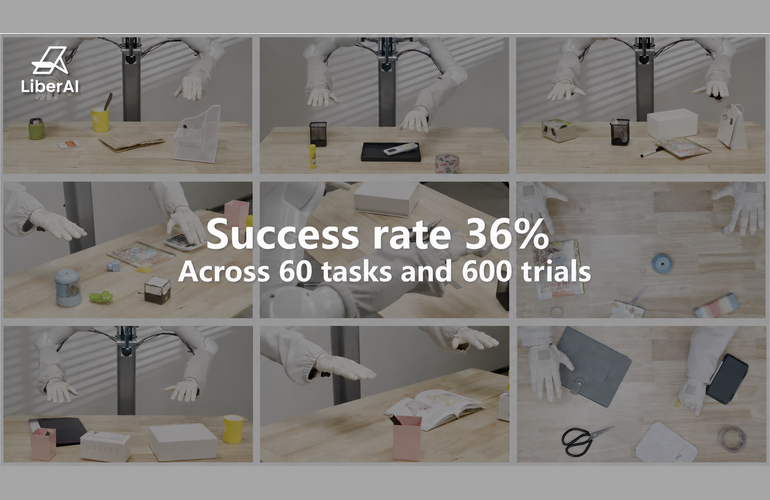
LiberAI, a Beijing-based physical AI startup, unveiled Liber-0 on November 4, a world action model built to transfer human manipulation skill directly to robots without collecting robot-specific demonstrations for every new task.
The model was pretrained on more than 2.2 million hours of human experience, combining large-scale human video, motion data recorded with the company's proprietary LiberSense glove, and a smaller set of robot demonstrations. Liber-0 jointly predicts future video frames and the physical actions that produce them, then uses what LiberAI calls a Unified Embodiment Representation to adapt those predicted actions across different robot bodies, according to The Robot Report.
How It Performed
LiberAI tested Liber-0 on 60 tasks proposed by GPT-6 across 600 trials, split into 20 pick-and-place tasks, 20 other manipulation tasks and 20 challenging multi-step tasks the model had not been specifically trained on. Liber-0 achieved 36% overall success without robot-specific demonstrations: 63.5% on pick-and-place, 34.0% on other manipulation tasks, and 10.5% on the hardest multi-step tasks. On LiberAI's internal benchmarks, where the model had more directly relevant training data, it scored 81.4% on pick-and-place and 72.3% on non-pick-and-place tasks.
"Grounding that experience in measured motion and aligning it with the robot's body is what turns it into robot capability," said LiberAI founder and CEO Songming Liu.
Why Zero-Shot Transfer Matters
Most robot foundation models today rely heavily on robot-collected demonstration data, which is expensive and slow to gather at scale. Competing approaches from labs such as Physical Intelligence and Google DeepMind's robotics group have pursued similar goals of generalizing from broad data sources, but LiberAI's emphasis on glove-tracked human motion as a bridge between internet video and robot action is a distinct bet: that precisely measured human hand movement, rather than video alone, is the missing ingredient for transferring skill across different robot embodiments.
The 36% zero-shot success rate on GPT-6-proposed tasks is modest in absolute terms, and the gap between that figure and the roughly 75% to 80% scores on LiberAI's internal benchmarks shows the model still performs best on tasks closer to its training distribution. That gap is a common pattern across world-action-model research and underscores how far the field remains from robots that can reliably handle truly novel manipulation tasks out of the box.
LiberAI has made an interactive simulation available where users can upload their own objects and watch Liber-0 attempt to manipulate them virtually, a step the company says is meant to invite outside testing of the model's generalization claims. The company has not disclosed funding details or a commercial release timeline for deploying Liber-0 on physical robot hardware beyond its own test platforms.