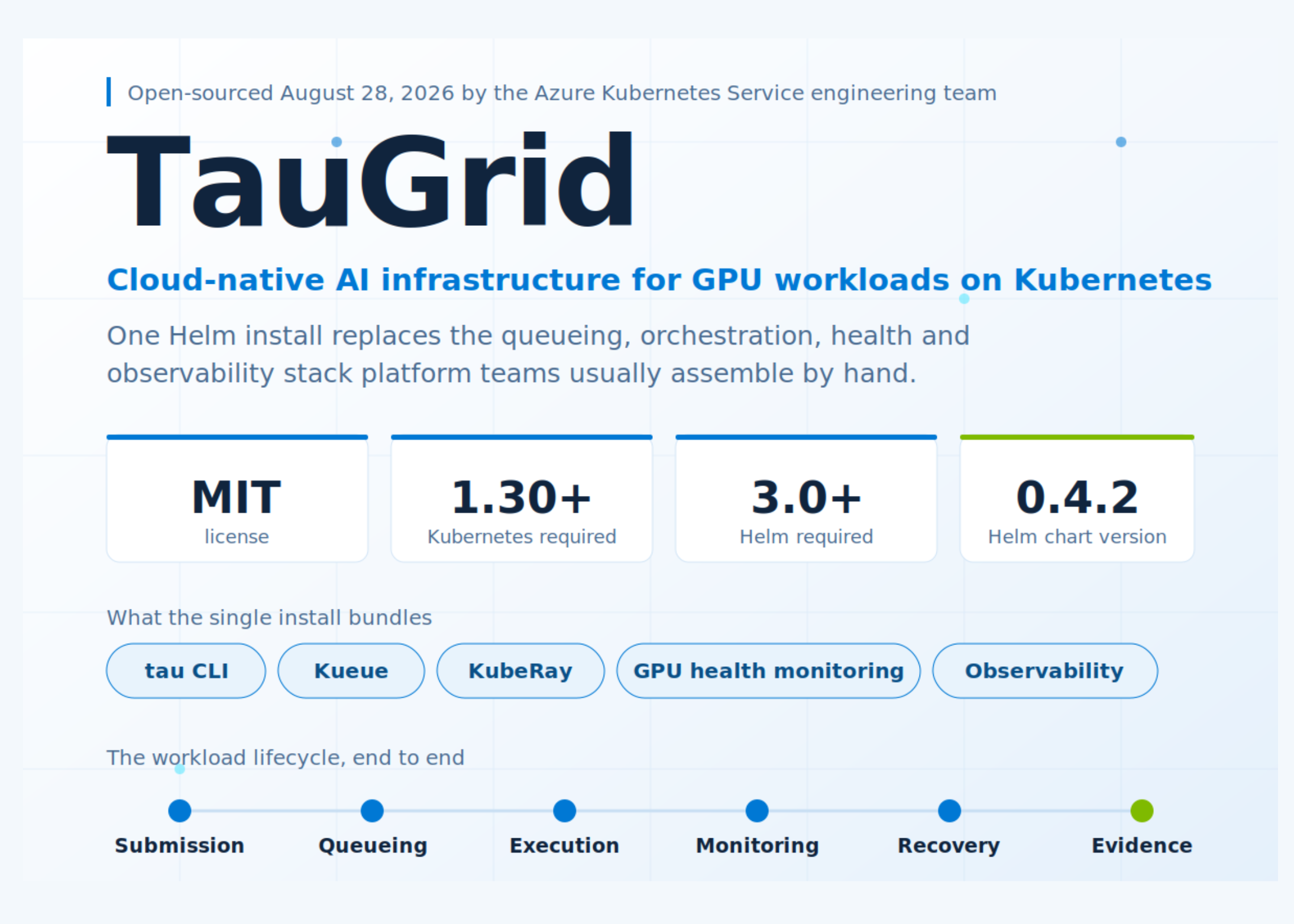
Microsoft's Azure Kubernetes Service engineering team has open-sourced TauGrid, a Kubernetes-native stack for GPU-heavy AI workloads that folds queueing, distributed orchestration, health monitoring and observability into a single Helm install. The project is available on GitHub under an MIT license as of a September 17, 2026 announcement that formalises the internal release Microsoft made on August 28.
What TauGrid Bundles
Platform teams typically stitch together Kueue for queueing, KubeRay for distributed training, custom GPU health scripts and a home-rolled observability layer to make Kubernetes usable for AI. TauGrid packages all four into one deployable unit — Microsoft describes it as collapsing "that assembly job into a single Helm install" on Kubernetes 1.30+ clusters with GPU nodes. The bundle also adds a first-party tau CLI, node-level GPU health probes and evidence records capturing configuration, logs, metrics and checkpoints for reproducible runs.

License, Telemetry And Availability
TauGrid is MIT-licensed via the Azure/taugrid GitHub repository, ships container images through Microsoft Container Registry (mcr.microsoft.com) and offers CLI installers for Linux, macOS and Windows. Notably, the project sends no telemetry to Microsoft by default, positioning it for regulated and on-prem deployments that cannot pipe metrics back to Azure.
Why It Matters
Open-sourcing TauGrid puts Microsoft in more direct competition with community stacks like Volcano, MLBatch and NVIDIA's own scheduler-plus-observability tooling. It also lands into a market where GPU queueing and reproducible ML infrastructure have become one of the loudest pain points for enterprises building out inference and training clusters, an appetite reflected in our recent coverage of Crusoe's $3.9B Series F and the Cisco-Splunk AI Pod launch.
Who It Is For
Microsoft is pitching TauGrid at three audiences: multi-team GPU clusters with shared queue policies, distributed PyTorch training on Kubernetes and any workload that has to be audit-trail ready. That map neatly onto customers already running AKS with GPU node pools, but the MIT license and lack of Azure-specific hooks mean TauGrid can be installed on any conformant Kubernetes cluster, including on-prem and other clouds.
Reporting based on coverage from InfoQ, MarkTechPost, Microsoft's AKS Engineering Blog and the Azure/taugrid GitHub repository.