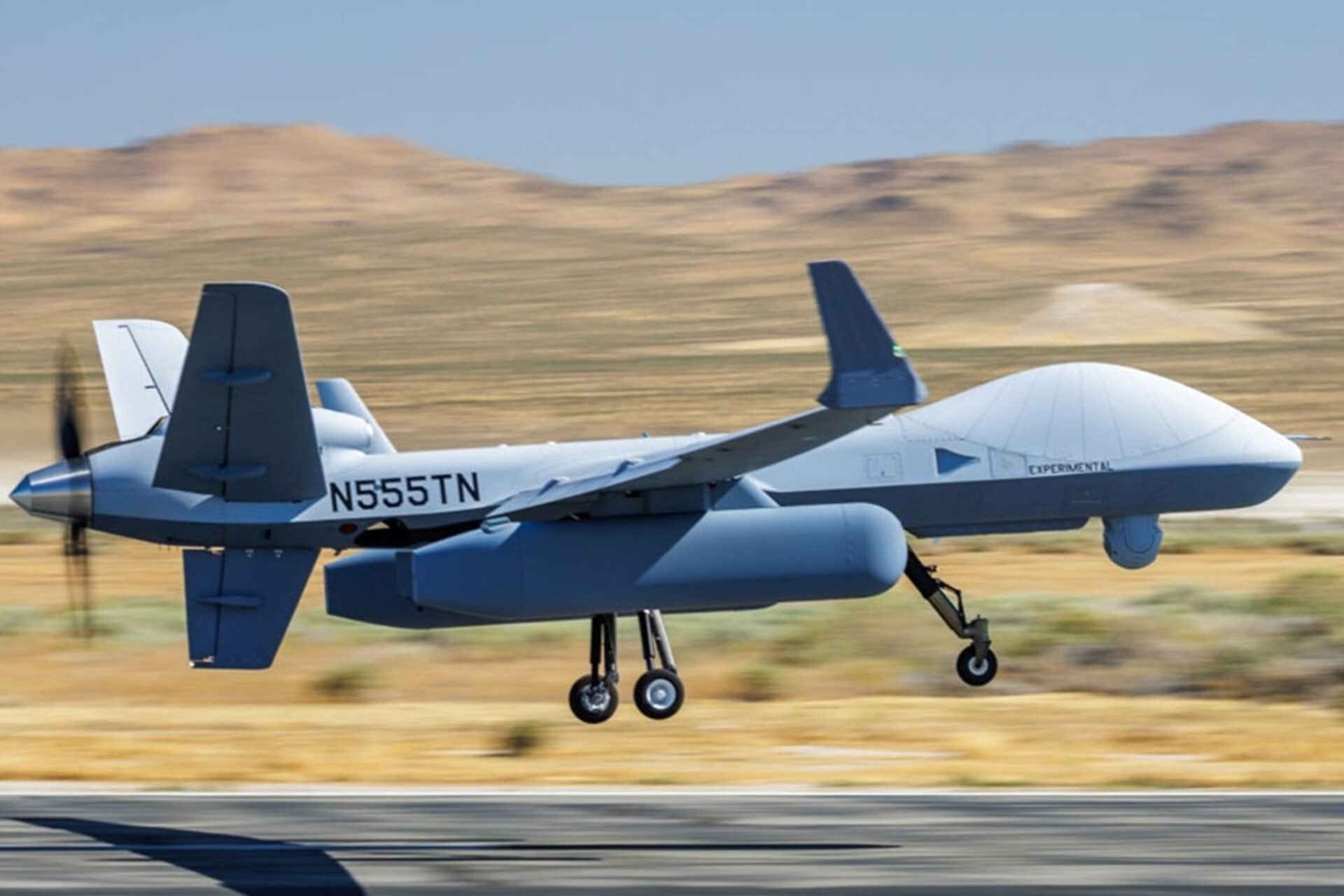
General Atomics Aeronautical Systems (GA-ASI) has flown its MQ-9B remotely piloted aircraft with Saab-supplied airborne early warning (AEW) pods for the first time, the manufacturer announced on May 21, 2026. The validation flight took place on May 19 from GA-ASI's Desert Horizon flight operations facility in Southern California using a company-owned MQ-9B.
A podded sensor called LoyalEye
The AEW sensor is branded LoyalEye and is being supplied through a Saab partnership first unveiled in 2025. GA-ASI described the sortie as the first step in a development process expected to run several months, with the two companies aiming to finish with a full-capability demonstration later in 2026. Neither company has named a launch customer for the AEW configuration.
Persistent surveillance without crews
GA-ASI President David R. Alexander framed the configuration as a way to defend against tactical air munitions, guided missiles, drones and crewed fighter and bomber aircraft without putting aircrews at risk. Carl-Johan Bergholm, Saab's senior vice president and head of its surveillance business area, described LoyalEye as an extension of crewed systems that can deliver persistent surveillance over both line-of-sight and satellite communications links.
A lower-tier complement to GlobalEye
The podded MQ-9B AEW concept sits at a different price point than Saab's flagship GlobalEye, a high-end multi-domain early-warning aircraft built on a Bombardier Global 6000 and recently selected by France. Where GlobalEye carries a large fixed Erieye Extended Range array, the LoyalEye pod is designed to provide longer-persistence surveillance in regions where crewed AEW assets are unaffordable or unavailable, broadening the reach of Saab's Erieye sensor family onto an uncrewed platform.
Expanding the MQ-9B mission set
For GA-ASI, the AEW role adds to a mission portfolio for an aircraft already sold across Europe to the United Kingdom, Belgium, Poland, Denmark and Germany, as well as to customers in Japan and India. A short-takeoff-and-landing MQ-9B variant under development for naval aircraft carriers could eventually open a path to shipborne unmanned early warning. The effort fits a wider defense shift toward uncrewed systems, echoing recent moves such as the Pentagon's $500M counter-drone deal with Perennial Autonomy, Draganfly's US Army counter-drone contract, and the delivery of L3Harris tactical robots to the Australian Defense Force.
Reporting based on coverage from AeroTime and General Atomics Aeronautical Systems.