The 2026 Robotics Summit & Expo wrapped Wednesday at Boston's Thomas M. Menino Convention and Exhibition Center with a moment that will define the event's legacy: Noland Arbaugh, the world's first recipient of a Neuralink brain-computer interface implant, demonstrated live neural cursor control onstage and received a standing ovation from a room full of robotics engineers who design the systems his neural signals may one day drive.
Inside the live BCI demonstration
Arbaugh, who has been paralyzed from the shoulders down since a 2016 diving accident, received Neuralink's N1 implant in January 2024 at Barrow Neurological Institute in Phoenix, becoming the first human patient in the company's PRIME clinical trial. The device uses 64 flexible threads carrying 1,024 electrodes to read neural activity in the motor cortex and translate intended movement into computer commands via Bluetooth.
In the closing session, titled "Rewiring What's Possible: A New Era of Human Potential," Arbaugh used the implant to control a cursor and described how the system has reshaped his daily life. He has used it to play chess, manage scheduling and study toward a neuroscience degree. He named the implant Eve and described it onstage as his "brain co-pilot." Speaking to the audience, he said, "It didn't just change what I can do. It changed what I believe I'm capable of."
Why robotics engineers were the audience
Continuous neural motor signals decoded from the motor cortex are exactly the input that robotic prosthetics, exoskeletons and teleoperated platforms have spent years trying to approximate from EMG sensors, eye-tracking and other indirect channels. A patient with thousands of hours of accumulated experience using a BCI offered something published research cannot: a working report on the latency, reliability and adaptation curve of direct brain-to-machine control under real-world conditions. Several companies on the expo floor are openly working toward driving end-effectors and assistive robots from neural signals.
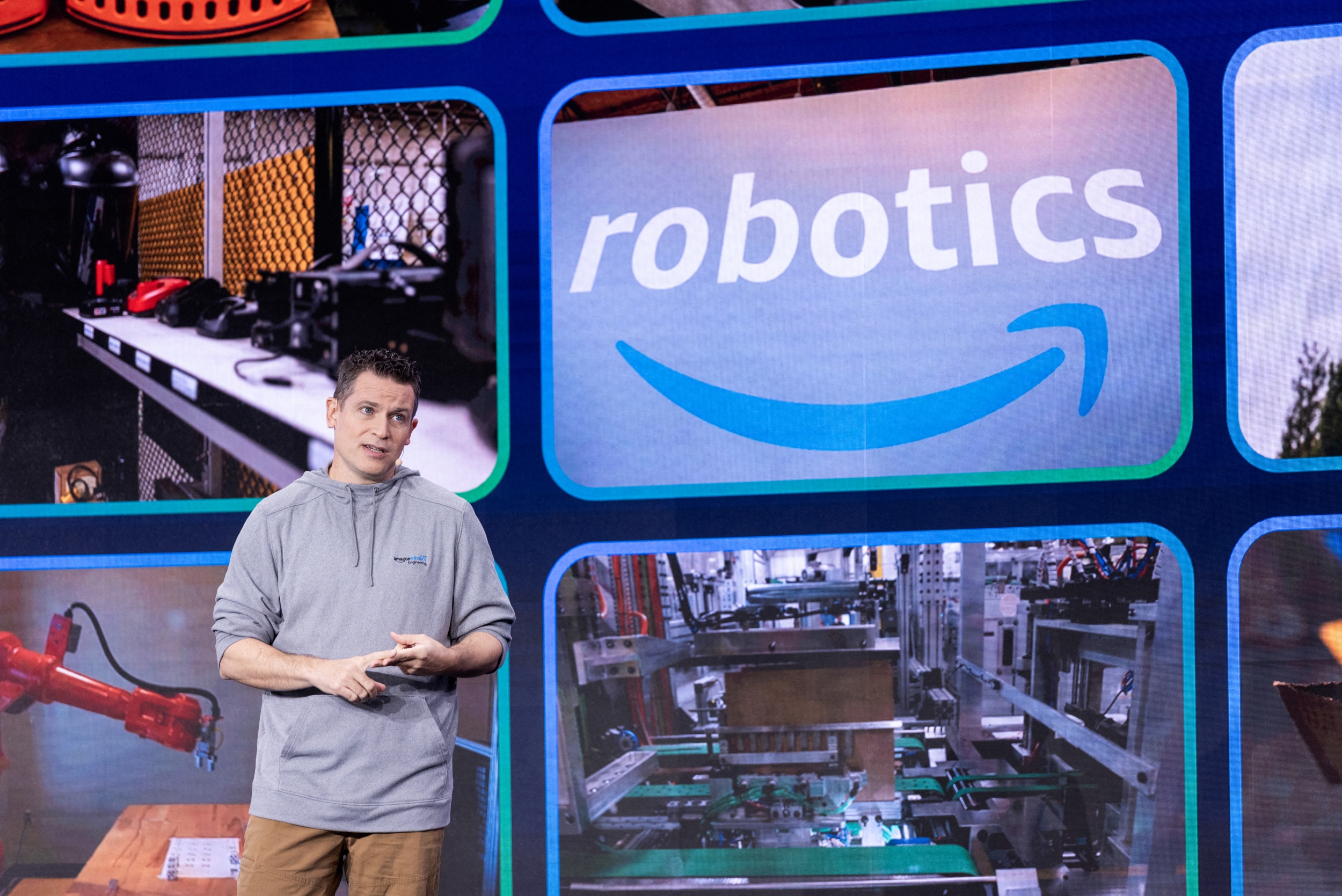
Amazon Vulcan named RBR50 Robot of the Year
The summit also handed out its annual RBR50 Robotics Innovation Awards on May 27. Amazon Robotics' Vulcan — the company's first warehouse robot with a genuine sense of touch — was named Robot of the Year. Vulcan uses AI-driven force and torque sensors to determine the precise pressure needed to grasp and stow individual items, allowing it to handle roughly 75% of the about one million unique items in a typical Amazon warehouse. It operates up to 20 hours a day, with a current deployment at a fulfillment center in Spokane, Washington and additional U.S. and German sites planned.
Agility Robotics' Digit took the inaugural Robot of the Year award in 2024, and Waymo won in 2025 for surpassing 150,000 paid autonomous trips per week. The 2026 selection of Vulcan is consistent with a broader industry shift toward physical AI systems that combine perception, force-sensing and learned policy execution — a frame echoed in Boston Dynamics work like our coverage of Atlas being trained to lift 100-pound loads in weeks, and in FANUC's industrial deal with Google detailed in FANUC Teams With Google to Bring Gemini AI to 1.1M Robots.
A summit framed by physical AI and supply chains
The two-day Boston event drew more than 5,000 robotics developers, more than 200 exhibitors and over 70 speakers across five tracks, including artificial intelligence, design and development, enabling technologies, healthcare and logistics. GM's Mikell Taylor delivered a Day 2 keynote arguing that reliability, economics, safety and human-robot trust — not capability showcases — are what win industrial procurement. MassRobotics also debuted its second Physical AI Fellowship cohort, including Burro, Config, Deltia.ai, Haply Robotics, Luminous Robotics, Roboto AI, Telexistence, Terra Robotics and WIRobotics. The summit took place alongside Taiwan's parallel physical-AI push at Computex 2026's new AI robotics zone, underscoring how concurrent ecosystems are now organizing around the same underlying compute and motor-control stack.
What comes next
The Robotics Summit's closing demo was effectively a preview of where the BCI and robotics communities meet. As Neuralink expands its PRIME study and competitors such as Synchron, Paradromics and Precision Neuroscience push their own implants, the engineering question shifts from whether BCIs can drive a cursor to whether they can reliably drive a robotic arm or exoskeleton over time. Arbaugh's onstage performance gave engineers a high-information benchmark for the work ahead.
Reporting based on coverage from Tech Times, The Robot Report and MassRobotics.