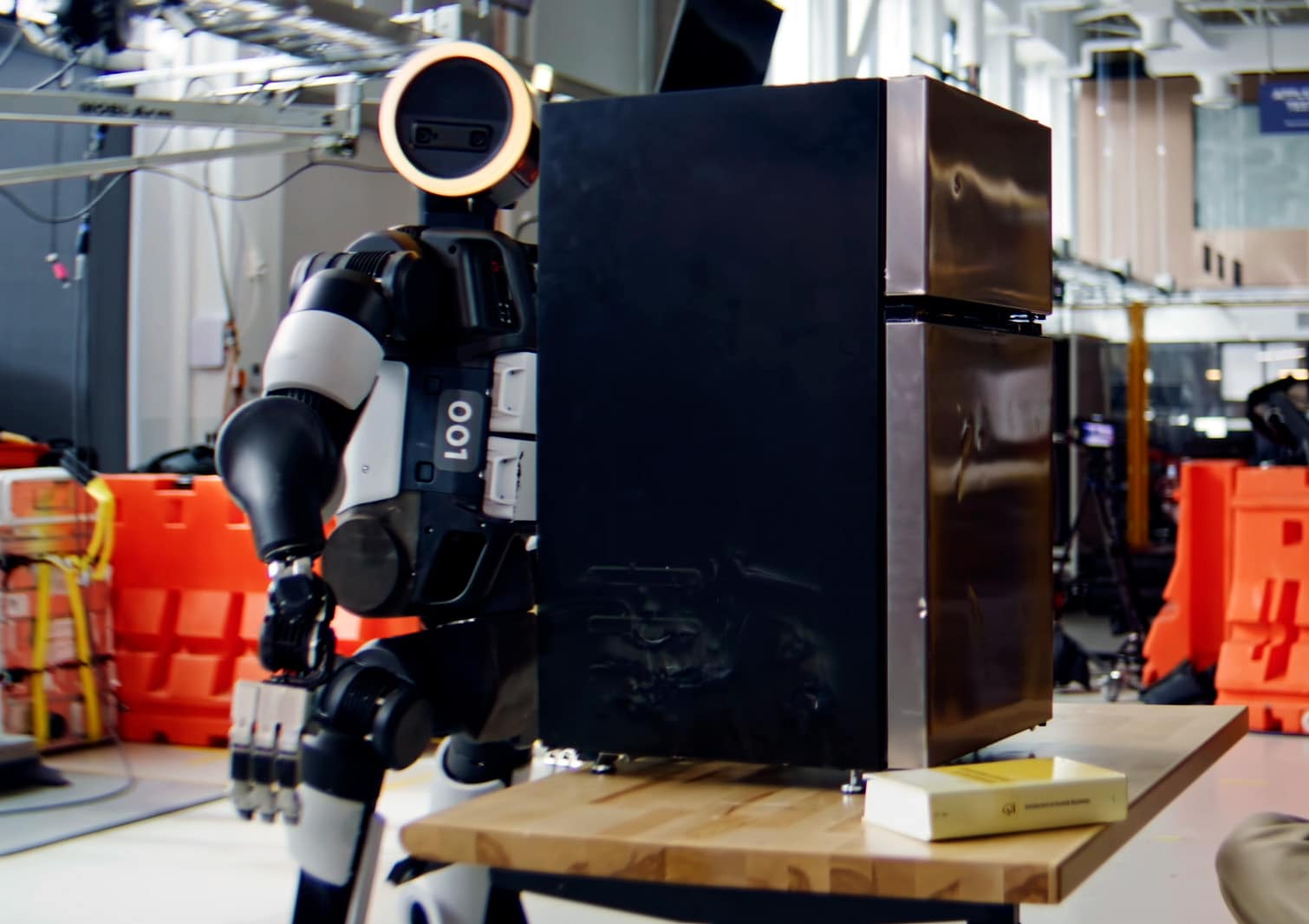
Boston Dynamics on May 18 detailed how its new electric Atlas humanoid was trained to lift and carry a loaded mini-fridge using whole-body reinforcement learning, a behavior the company describes as a benchmark for industrial work involving awkward, two-person lifts. The post, written by Atlas director of robot behavior Alberto Rodriguez and research engineers Shane Rozen-Levy and Vinay Kamidi, accompanies a video that has drawn outsized attention since the robot's January debut.
From animation to a robust lifting policy
According to Boston Dynamics, training started with a hand-animated reference trajectory of the lift, rather than a teleoperated demonstration. The team then defined rewards that asked the policy to keep the fridge stable in the grippers and at the correct orientation while disturbances were injected, so Atlas would learn to recover under pushing, pulling and shifting payloads.
The policy was trained for "millions of hours" in parallel on GPU-accelerated simulation, with domain randomization varying mass, friction, motor strength and grip. Despite being trained only on 50-70 pound loads, Atlas successfully moved a fridge weighing more than 100 pounds in real testing, with contents that were unevenly distributed and free to shift mid-lift.
Why whole-body control matters for real work
Boston Dynamics frames the demonstration as a deliberate move beyond table-mounted manipulation and fingertip-only grasping. The company argues that humanoid robots tackling factory, warehouse or construction work must use forearms, biceps, knees and torso to shoulder loads, and adapt to objects via haptic and proprioceptive feedback rather than continuous camera input.
That philosophy is reflected in the latest Atlas hardware: the robot stands roughly 90 kilograms (198 pounds), uses just two types of rotary actuators across the body, and features field-replaceable arms, legs, hands and head. Eliminating cables across joints allows infinite rotation and removes a major source of actuator failures, the company said.
Closing the sim-to-real gap
A central claim in the post is that the new Atlas has an unusually small sim-to-real gap. Because the robot uses standardized actuators and a symmetric mechanical layout, Boston Dynamics says its high-fidelity simulator can model the hardware closely enough that "what you see in sim is what you get in reality." Engineers can train a new policy one day and test it on the robot the next, then iterate, the team wrote.
Reinforcement learning combined with domain randomization is increasingly seen as a faster path to deploying humanoids in industrial settings than imitation learning alone. Boston Dynamics' rivals are pursuing similar strategies: FANUC and Google are bringing Gemini-based physical AI to 1.1 million industrial robots, while Hyundai plans to deploy up to 25,000 Atlas units across its US plants.
Scaling beyond fridges
Boston Dynamics says its goal is to train and deploy new Atlas behaviors in as little as a day, and that the fridge sequence was a milestone in that direction. Less pragmatic stunts like handstands and backflips are now treated as test cases for thermal management, range of motion and recovery from slips, all of which transfer to industrial environments.
The grippers used in the fridge experiment are the same workhorse units Boston Dynamics has employed for the past 18 months. The company said it has started experimenting with a newer dexterous gripper that will be detailed in a future update. With Atlas units already committed to Hyundai's Robotics Metaplant Application Center and Google DeepMind, the next test will be whether reinforcement-learned lifting policies can hold up under the variability of real factory floors. For broader humanoid industry context, see our coverage of the humanoid robot market outlook.
Reporting based on coverage from Boston Dynamics, Robotics & Automation News, and Interesting Engineering.