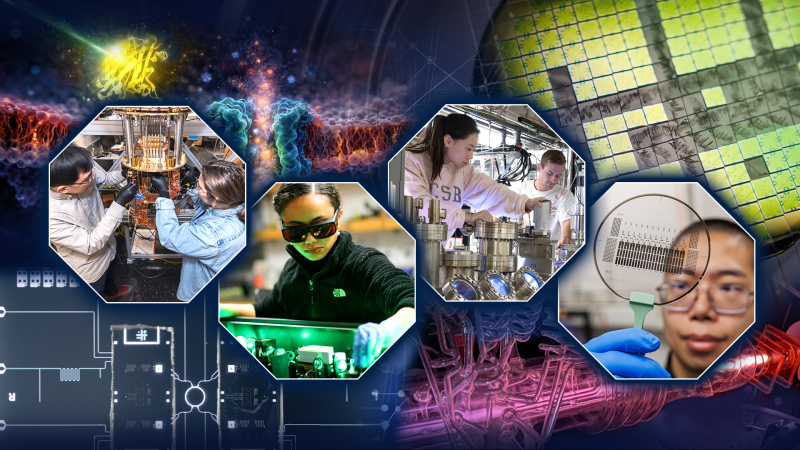
The U.S. National Science Foundation announced on August 25, 2026 that it will invest more than $290 million across eight NSF Quantum Leap Challenge Institutes (QLCIs), expanding a program launched in 2020 under the National Quantum Initiative Act. Three of the institutes are newly formed; five previously funded QLCIs will be renewed. Each will receive between roughly $28 million and $37 million over five years.
Scope: 36 universities, 19 states, 30 corporate partners
NSF said the expanded QLCI program will support researchers in 19 states across 36 institutions of higher education. Federal collaborators include U.S. Department of Energy national laboratories, NIST and the Department of War, while more than 30 U.S. companies are working with the institutes on translating fundamental science into industrial production. The eight institutes together cover fault tolerance, quantum error correction, hybrid quantum networks, superconducting qubits, quantum sensing for biophysics, quantum simulation, and quantum computation architectures spanning neutral atoms, trapped ions and solid-state systems.
Princeton leads new $27.9M MARQUIS institute
Princeton University will lead the new NSF Institute for Manufacturable and Resilient Superconducting Quantum Information Systems (MARQUIS) with $27.9 million over five years. MARQUIS will use materials science and semiconductor fabrication techniques to build higher-quality Josephson junctions — the core electronic components inside superconducting quantum computers. The remaining two new institutes are NSF FTQSAA, focused on fault-tolerant systems and architectures, and NSF PRACTIQAL, targeting practical quantum error correction methods.

Renewals: HQAN, CIQC, QuBBE, Q-SEnSE, RQS
The five renewed institutes include NSF HQAN (hybrid quantum architectures and networks, at the University of Illinois), NSF CIQC (quantum computation, at UC Berkeley), NSF QuBBE (quantum sensing for biophysics and bioengineering, hosted at the University of Chicago), NSF Q-SEnSE (precision sensing and measurement, at CU Boulder), and NSF RQS (robust quantum simulation, at the University of Maryland). Each will continue work started in 2020 or 2021 on subjects ranging from atomic clocks and quantum nanoprobes to simulation architectures for large-scale systems.
Aligned with growing quantum industry
NSF's award follows a wave of quantum programme activity in 2026, including QOBLIB benchmarking work from IBM, Zuse Institute Berlin, TU Berlin and Purdue, and early-stage quantum software funding rounds. NSF said the QLCIs will also train hundreds of graduate students, undergraduates and early-career researchers through partnerships with community colleges, high schools and K-12 teacher programs over the next five years.
Reporting based on the U.S. National Science Foundation announcement, HPCwire, Quantum Computing Report, Princeton Engineering and The Quantum Insider.