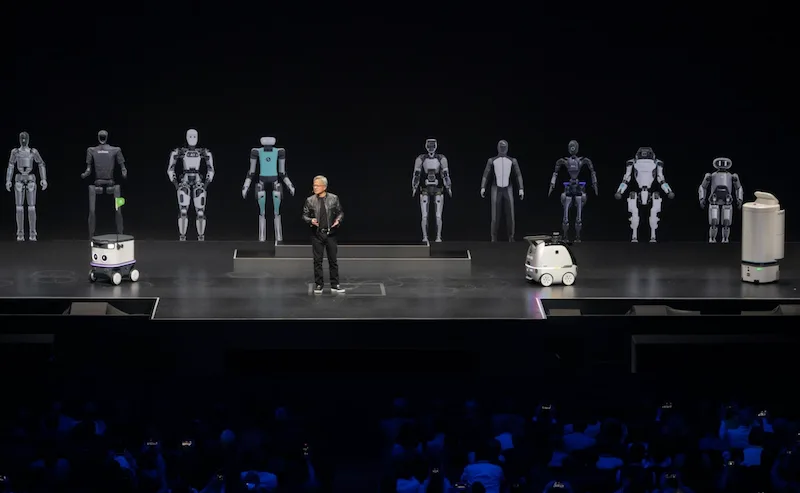
Nvidia's board accepted Jensen Huang's resignation as CEO on November 12, 2026, installing chief financial officer Colette Kress as interim chief executive while directors search for a permanent replacement. The move ends a 33-year run at the helm of the company that, more than any other chipmaker, bankrolled the current wave of robotics investment. Robotics executives and analysts are now openly debating whether that momentum survives his departure, according to a report from The Robot Report.
Huang was not just a chip supplier to robotics companies. He was the industry's most visible evangelist at events where few other semiconductor executives bothered to show up. Nvidia's physical AI revenue has nearly tripled year over year and is projected to top $25 billion in fiscal 2027 — a figure that still represents only around 6% of Nvidia's projected $400 billion-plus annual revenue, but one that has underwritten a generation of humanoid and industrial robot startups through Nvidia's Jetson edge chips, Isaac simulation software and its NVentures investment arm.
Why the Industry Is Nervous
Commercial robotics, unlike cloud computing or gaming, has no settled business model yet. Humanoid makers are still proving out factory and warehouse use cases, and much of the capital flowing into the sector has leaned on a narrative Huang personally built, keynote after keynote, by showcasing startups on stage, open-sourcing simulation tools and insisting robots would reshape manufacturing within the decade. Yaro Tenzer of RightHand Robotics told The Robot Report that Huang was \"fantastic in painting the vision\" for a sector that still struggles to explain itself to mainstream investors. Jan Zizka of Brightpick and Photoneo was blunter: \"The best possible case is that it will continue. But I think this is a negative.\"
The concern is not that Nvidia stops shipping chips. It is that the marketing and ecosystem-building Huang did personally — flying startups onto his stage, name-checking tiny robotics companies in front of thousands of developers — does not survive a leadership transition focused on cost discipline and AI data-center demand. Nvidia's December 2023 rescue financing of Serve Robotics, which Huang led personally when the sidewalk-delivery company was close to running out of cash, is the kind of founder-level intervention that a CFO-turned-interim-CEO is unlikely to replicate. Serve went public four months later.
The Competitive Picture Without a Cheerleader
Rivals to Nvidia's robotics stack — Qualcomm, AMD, and a wave of Chinese edge-AI chipmakers — have been gaining ground on cost and power efficiency rather than ecosystem reach. None of them has matched Nvidia's software moat in Isaac Sim and Omniverse, built over nearly a decade with Huang pushing engineering resources toward robotics even when the segment was a rounding error on Nvidia's income statement. Without that internal champion, robotics could lose priority against Nvidia's far larger data-center and AI infrastructure businesses the next time resources get allocated.
Robert Little, former CEO of ATI Industrial Automation, argued the sector has already passed the point of no return: \"The flywheel has been created and it is spinning now... we're too far in.\" That view rests on the idea that customer deployments, not keynote slides, now drive demand. Hyundai's Boston Dynamics, Figure, Agility Robotics and dozens of Chinese humanoid makers have built their own momentum independent of any single Nvidia executive. Still, the next few quarters — including whether a permanent CEO keeps robotics on Nvidia's main stage at CES and GTC — will show whether Huang's departure is a footnote or a turning point for the industry he spent years building.