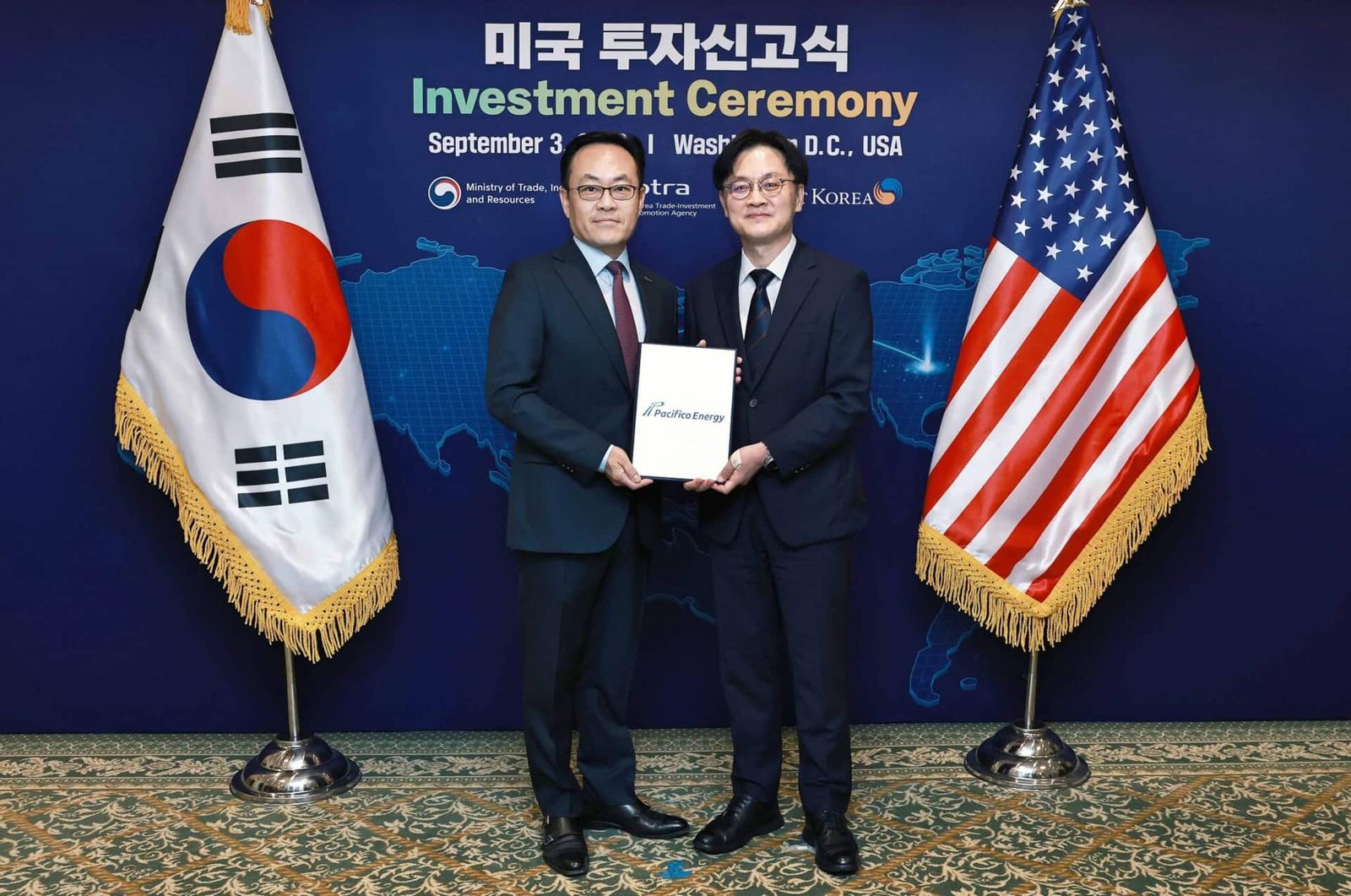
US-based renewable energy developer Pacifico Energy has committed more than $1 billion (about €861 million) to the second and third phases of its 3.2 GW Jindo offshore wind cluster in South Korea, deepening one of the region's largest single-developer offshore wind pipelines.
$1 billion tied to Manho and Jindo Baram
Pacifico Energy Korea, the group's local development arm, submitted the investment declaration to South Korea's Ministry of Trade, Industry and Resources (MOTIR) on 3 September during a US Investment Ceremony co-hosted with the Korea Trade-Investment Promotion Agency. The pledge covers the 990 MW Manho project and the 1.8 GW Jindo Baram project — Phase 2 and Phase 3 of the Jindo cluster off Jeonnam-Gwangju Special Metropolitan City.
The two projects were consolidated in August under South Korea's new government-planned model when Pacifico Energy Korea was named sole developer of the 2.13 GW Jindo Phase 2 Offshore Wind Integrated Cluster, a designation that streamlines permitting and grid allocation for both projects.
A 3.2 GW Asia-Pacific anchor
The Jindo cluster comprises three projects — the 420 MW Myeong Ryang, 990 MW Manho and 1.8 GW Jindo Baram — for a combined 3.2 GW nameplate capacity. Myeong Ryang, the first phase, secured its Electricity Business License in September 2025 and completed its preliminary Environmental Impact Assessment in March 2026; the Manho and Jindo Baram EBL applications remain under review.
Local supply chain and financing partners
Pacifico Energy Korea has been building a Korean industrial base for the buildout. In July it signed a memorandum of understanding with foundation manufacturer EEW KHPC, marine logistics operator KMC Line and foundation-component supplier CS Energy to structure a dedicated supply chain, following a June MoU with Hana Bank and Hana Securities on project financing across development, construction and operations.
South Korea's offshore wind reset
The pledge lands as Seoul restructures its offshore wind sector around designated cluster zones and pre-selected developers, replacing the previous developer-led site-selection model. It follows Denmark's 1.8 GW Hesselø North Sea I award to Vattenfall in August, another sign that governments are moving from open tenders toward pre-planned, cluster-based offshore wind procurement. It also stacks on top of the Philippines' MTerra Solar Phase 1 solar-plus-storage inauguration as Asia-Pacific commissions record renewable capacity in 2026.
Reporting based on coverage from offshoreWIND.biz, ESG News and reNEWS.