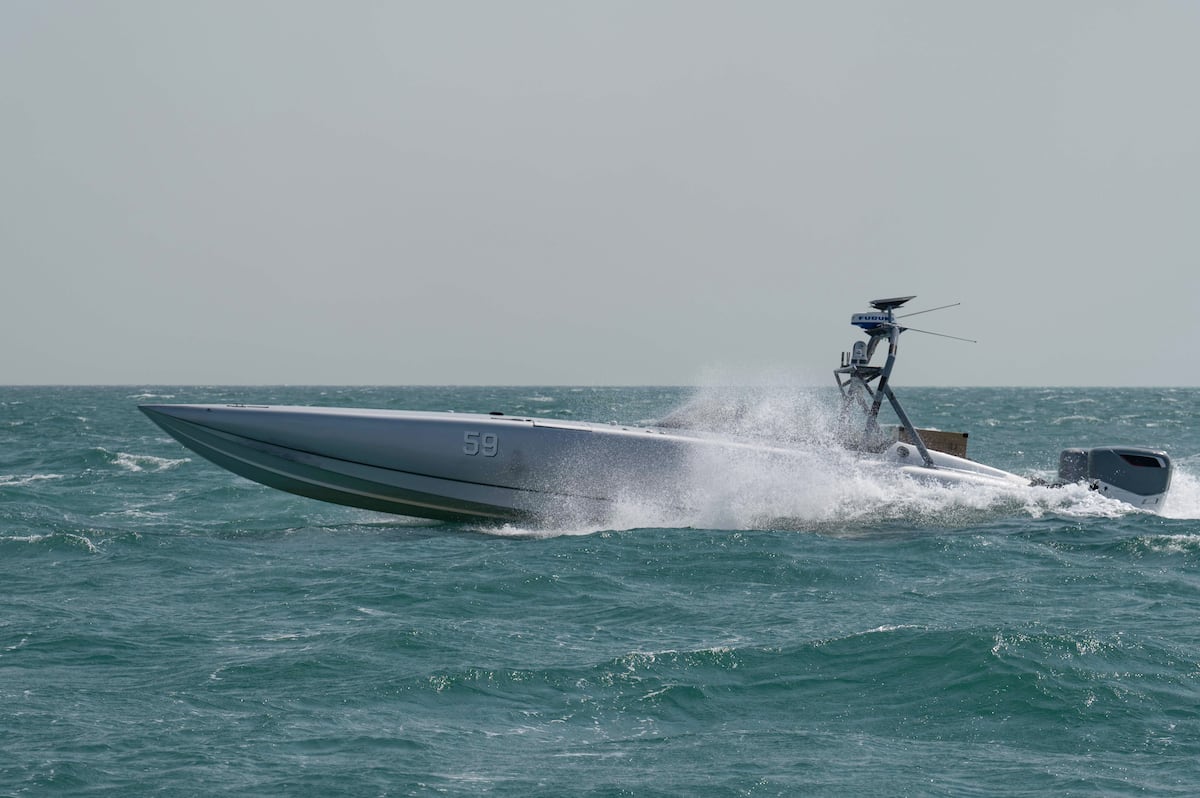
The Pentagon is racing to field a cheap counter to swarms of unmanned boats and small drones in contested waters like the Persian Gulf. On Tuesday the Defense Innovation Unit posted a solicitation for SWAP-USV — Suitable Warfighting Adaptive Payloads Unmanned Surface Vessel — a year-long prize challenge backed by $100 million in prize money and $200 million in follow-on procurement for drone boats that carry, launch and control at least two small attack drones.
120 days from selection to in-water testing
DIU wants "mature, market-ready USVs fully integrated with two or more mature, market-ready aerial drones to detect, identify, track and defeat hostile threats." Sprint 1 vendors must field a complete mission-ready USV within 29 days of down-selection, with in-water testing in fall 2026. Sprint 2 focuses on expanded payloads, upgraded autonomy and multi-vendor integrations, with testing in early 2027. Sprint 3 will publish its objectives later. Vendors that pass each phase are eligible for procurement contracts backed by a $200 million budget.

Fixing the wrong-side-of-the-cost-curve problem
DIU's own filing is blunt about the economics: "The cost-exchange ratio for detecting and neutralizing asymmetric maritime threats in contested environments is heavily skewed in favour of the adversary," it wrote, adding that the US military cannot keep spending "on exquisite, multi-million-dollar naval and aviation assets to intercept these inexpensive targets." The solicitation also lists drug-cartel go-fast boats and semi-submersibles among the threats the SWAP-USV should be able to shadow and intercept autonomously.
A busy month for unmanned maritime
The call arrives the same week the US Navy staged its first live-fire training exercise with a GARC uncrewed surface vessel and days after missile-armed Saildrone Surveyor joined RIMPAC 2026 in Pearl Harbor. The SWAP-USV programme also complements Fincantieri's €600M underwater push and Kraken Robotics' Covelya acquisition. Vendors have until 10 August to respond.
Reporting based on coverage from Defense News, DIU and the US Navy.