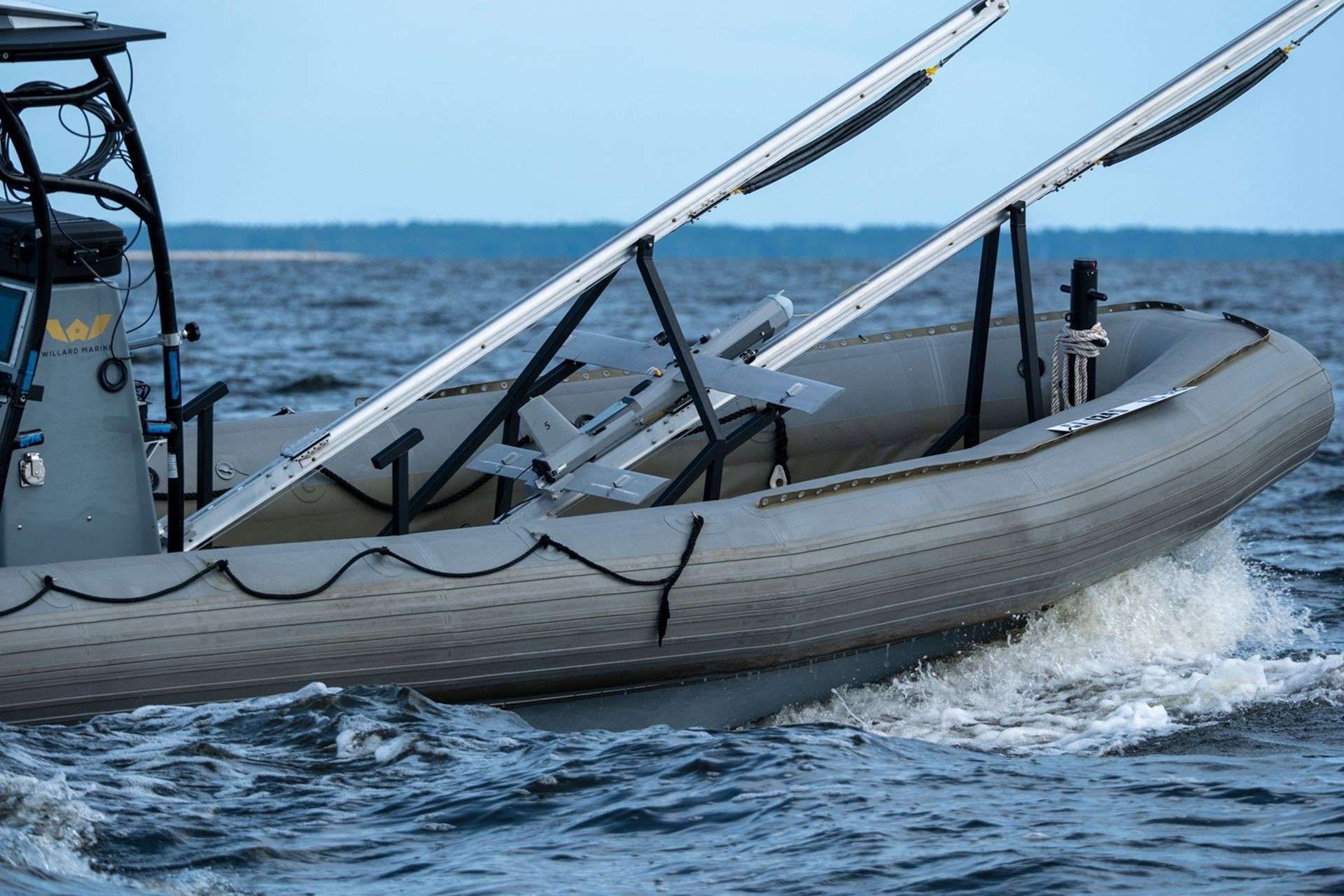
Florida-based Powerus announced Blue Sky Horizon on November 23, 2026, a conversion system that turns ordinary commercial boats, workboats and naval craft into uncrewed surface vessels fitted with bow-mounted launch rails for long-range aerial drones. The system bundles autonomy software, navigation sensors, communications gear and remote control hardware into existing hulls, so operators do not need to build a new vessel from scratch to get a drone-launching platform, according to Army Recognition.
The announcement landed the same day Ukraine's 40th Separate Marine Brigade released footage reportedly showing Barracuda unmanned surface vessels carrying heavy aerial drones across open water before launch, extending how far inland the drones could reach before running out of range. Powerus has not confirmed its equipment was used in that operation, but the company is explicit that the footage illustrates the concept Blue Sky Horizon is built around.
Why converting a boat beats building a drone
Every aerial drone has a range limit set by its battery or fuel. Launching from shore wastes a chunk of that range just getting the drone to the fight. Powerus's pitch is simple: let a boat carry the drone most of the way there, so the aircraft's limited endurance is spent on the mission instead of the commute. That math gets more attractive the farther the target is from friendly coastline, which is exactly the problem Ukraine has faced operating against Russian positions across the Black Sea.
Converting existing boats rather than designing a dedicated USV from the keel up is also a manufacturing shortcut. Shipbuilding is slow and capital-intensive; retrofitting a commercial hull with sensors, autonomy software and a launch rail is comparatively fast and can be done at scale using vessels that already exist. For a company trying to win Pentagon production contracts worth up to $1.1 billion, as Powerus has pursued, speed to volume matters as much as the technology itself.
A crowded, politically charged field
Powerus is not the only company chasing boat-to-drone conversions. Ukrainian forces have been experimenting with uncrewed surface vessels carrying strike drones and loitering munitions for over a year, and several Western defense contractors are racing to productize similar concepts for NATO navies. What sets Powerus apart is less the engineering than the backing: the company, founded in 2025 and headquartered in West Palm Beach, has drawn investment from Eric Trump and Donald Trump Jr.'s American Ventures vehicle, alongside a reported $50 million commitment from Korea's KCGI and a $30 million stake from drone component maker Feifan Machinery.
That political proximity has made Powerus one of the most closely watched new entrants in US drone manufacturing, but it also invites scrutiny of how much of its roughly $60 million in disclosed funding has translated into fielded hardware versus announcements. The trade-off for the Pentagon and allied buyers is the same one that applies to any fast-moving defense startup: lower cost and faster iteration against unproven reliability at the scale these contracts assume.
Blue Sky Horizon's real test will not be the unveiling but whether Powerus can retrofit enough hulls, fast enough, to matter in a conflict where Ukraine has already shown the tactic works without American technology at all. If the company can undercut dedicated USV builders on price while matching their reliability, it could carve out a meaningful slice of a market that barely existed three years ago.