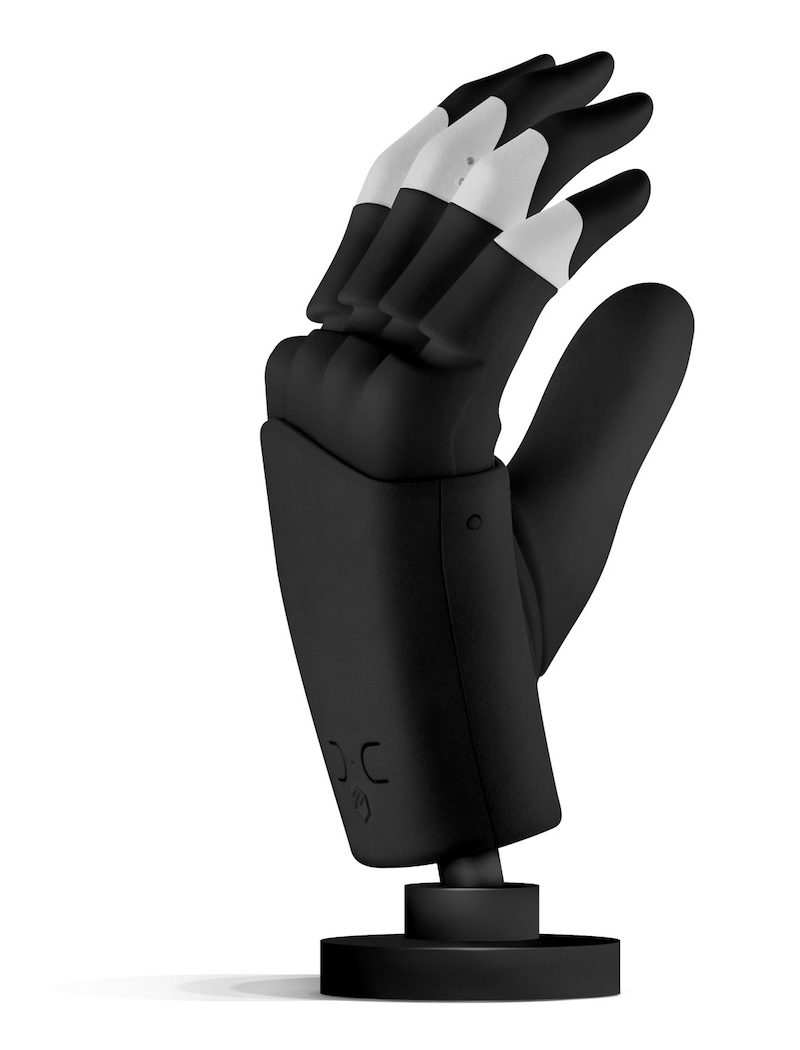
Prensilia, an Italian robotics company based in Pontedera, launched its NH1 Era robotic hand on November 27, 2026 at the SPS automation trade show in Nuremberg, Germany. The hand is built to attach to humanoid robots and collaborative robots, known as cobots, and targets factory tasks such as kitting, machine loading and unloading, and handling delicate components. Pre-orders for the first production batch are open now through Prensilia's website with no payment required to reserve a unit.
Founded in 2009, Prensilia has built its reputation on research-grade prosthetic and robotic hands for laboratories and universities. NH1 Era is its push into commercial factory hardware, a different customer base with different demands around durability, cost and ease of integration.
How does the hand actually grip different objects?
NH1 Era uses what Prensilia calls underactuated fingers. In a fully actuated hand, every joint has its own motor; underactuation means fewer motors drive multiple joints through mechanical linkages, letting the fingers passively conform to an object's shape instead of requiring a computer to calculate the exact grip for every item. That mechanical intelligence is what lets the same hand pick up a screw and a bulky bin without reprogramming.
The hand can apply up to 70 newtons of force through its thumb fingertip, roughly the force of a 7-kilogram weight pressing down, enough for tasks like firmly seating a connector. Tri-axis force sensors in the fingertips measure pressure from three directions at once, giving the hand's control software feedback on whether it is gripping too loosely or too hard, a safeguard for fragile parts.
On the integration side, NH1 Era runs on up to 48 volts and communicates over RS-485 and Ethernet, two common industrial communication protocols, and includes a mechanical interface built to the ISO 9409-1 standard used across robot arms. Prensilia also ships ROS libraries, software tools built on the Robot Operating System that let engineers plug the hand into existing robot control code rather than writing drivers from scratch.
Why does a robot hand matter more than a robot arm right now?
Robot arms have been commodity hardware for decades; hands have not. As humanoid robot makers like Figure, Agility and Tesla race to put machines into warehouses and factories, the bottleneck has shifted from moving an arm to the arm's whole point, grasping an object reliably. Several startups, including OYMotion and SynapX, have raised large rounds this year specifically to mass-produce robot hands, signaling that investors see the gripper as a separable, sellable product rather than something every robot builder must engineer in-house.
Prensilia is positioning NH1 Era as hardware any manufacturer can bolt onto its own humanoid or cobot platform, rather than a hand tied to one robot brand. That cross-platform approach puts it in direct competition with specialized hand suppliers now scaling in China and the U.S., in a market where the hand, not the torso, increasingly decides whether a robot is useful on a real production line.
The company has not disclosed pricing or a shipping date for the first production batch beyond opening pre-orders, leaving open how quickly NH1 Era can move from trade-show launch to factory floor. Source: Robotics and Automation News.