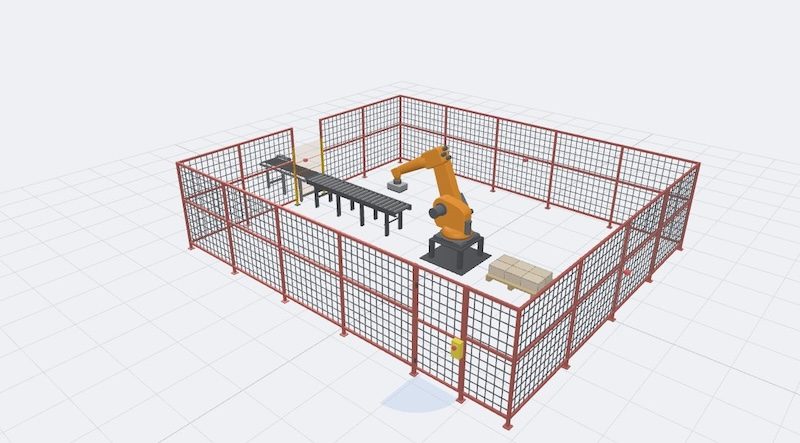
UK startup Path2 has built a browser-based platform that lets manufacturers lay out, simulate and program an industrial robot cell without writing a line of robot code. In a demonstration on a real Kuka KR 210 R2700 extra, founder Sam Reynolds says the tool went from a blank layout to a running production cycle in 19 minutes — no KRL written, no positions taught on the pendant, no manual edits, according to Robotics & Automation News.
The platform currently supports 20 Kuka robot models spanning 20 to 800 kilograms of payload, with ABB, Fanuc and Universal Robots support planned. Users position robots, conveyors, pallets and safety guarding in a virtual cell, teach positions directly on screen, and let the software check reach and generate a working program. Browser-based design tools are free; a single robot cell design package costs £495, or £99 a month for unlimited packages. Path2 is recruiting beta evaluators now, with commercial downloads due shortly.
The bottleneck isn't the robot, it's the integration
Robot arms have gotten cheaper for a decade. What hasn't gotten cheaper is the systems integration around them — the safety guarding, the conveyor layout, the programming, the commissioning — which routinely costs two to three times the price of the robot itself for a small manufacturer. That gap is a big reason robot adoption among small and mid-sized factories still lags large OEMs, even as overall orders climb: North American robot orders rose nearly 25% in the third quarter of 2026, and Japanese orders jumped 46.6% to a record ¥325.4 billion, driven overwhelmingly by large automotive and electronics buyers with in-house integration teams.
Path2 is explicitly targeting the manufacturers left out of that boom — shops with no systems integration budget and no robot programmer on staff. Reynolds, a chartered engineer and certified machinery safety expert, built the pitch around speed and cost: a 19-minute cycle versus what can be days of integrator time and tens of thousands of pounds in consulting fees for a comparable cell.
A crowded lane with an unusual entry point
Offline robot programming and simulation isn't new. ABB's RobotStudio, Kuka.Sim, Fanuc's Roboguide and third-party tools like RoboDK and Visual Components have offered virtual cell design for years, and Nvidia's Isaac Sim is pushing deeper into the same territory for more complex, AI-driven applications. What those tools generally assume, though, is an engineer who already knows how to use them — they're built for integrators, not for a small manufacturer's production manager.
Path2's bet is that a genuinely no-code, browser-first, single-seat-priced tool can pull in customers who were never going to hire an integrator at all, rather than competing head-on for the enterprise simulation budget. The trade-off is reach: supporting only Kuka at launch narrows the addressable market considerably, and reach-checking plus program generation inside a browser is a much harder claim to stand behind across every real-world safety edge case than it is in a demo video. Future versions, per the company, will bundle complete engineering packages — including programs, layouts, drawings, parts lists, electrical documentation and commissioning checklists — alongside built-in machinery safety guidance covering risk assessments and CE marking compliance, the regulatory paperwork that often scares small manufacturers away from automation projects altogether. Whether Path2 can extend to ABB, Fanuc and Universal Robots quickly, and whether its generated programs hold up to independent safety audits, will determine if this becomes a genuine option for first-time automators or stays a niche tool for Kuka shops willing to take a chance on a startup.