
The German federal research ministry has awarded €122 million (roughly $138.8 million) to a QUDORA-led consortium to build a 1,000-physical-qubit, 50-logical-qubit fault-tolerant trapped-ion quantum computer - and, crucially, a semiconductor pilot line to mass-produce the underlying quantum processing units.
The NFQC-1k programme
The award, announced on September 23, 2026, comes from the Bundesministerium für Forschung, Technologie und Weltraum (BMFTR) under the country's High-Tech Agenda Deutschland. The winning bid, dubbed NFQC-1k, will run for up to five years and is one of six consortia competing for a total €640 million pot in Germany's Quantum Computing Competition.
Targets are unusually explicit for a national programme: at least 1,000 physical qubits, at least 50 logical qubits, and a logical two-qubit gate error rate below 0.01%, verified via a Quantum Fourier Transform benchmark. A parallel workstream will stand up a QPU pilot line inside the consortium to prove that the chips can be produced at scale.
Seven-partner consortium
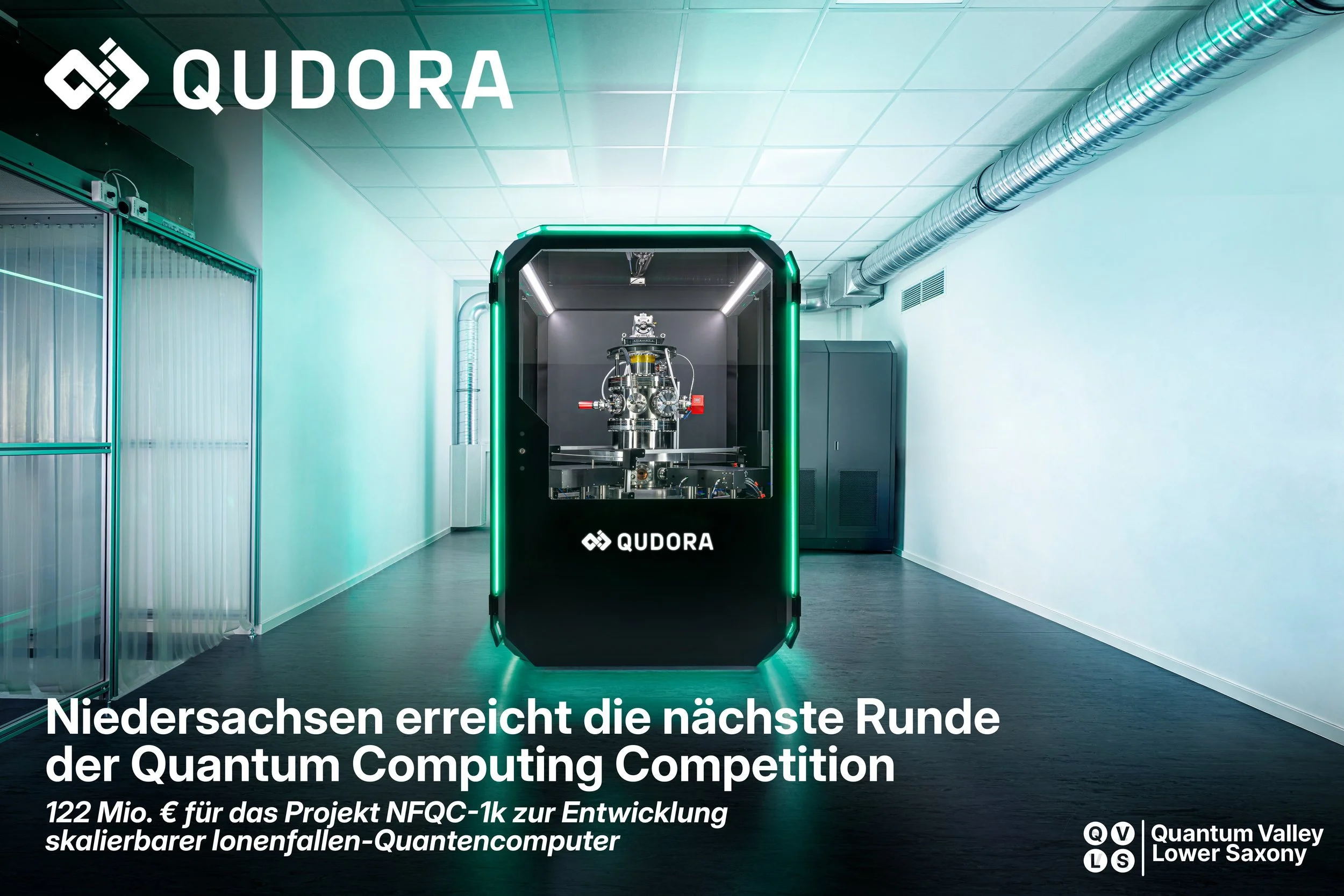
QUDORA Technologies leads system integration, contributing its proprietary Near Field Quantum Control (NFQC) trapped-ion platform, which swaps out laser arrays for chip-integrated microwave fields to make the hardware semiconductor-manufacturable. Alpine Quantum Technologies subsidiary AQT Germany brings decades of ion-trap engineering from Innsbruck. NXP Semiconductors Germany contributes the semiconductor pilot-line know-how.
The research half of the consortium is anchored by TU Braunschweig, Leibniz University Hannover, the national metrology institute PTB, and Forschungszentrum Jülich, which will supply high-performance computing capacity via its JUPITER-class exascale system.
Quotes and context
"Fault tolerance isn't achieved by improving single qubits alone - building architectures with thousands of resilient qubits operating reliably matters most," said QUDORA CEO Amado Bautista-Salvador in the announcement. COO Henning Hahn called the award "a vote of confidence in our technology and our partners' expertise within Quantum Valley Lower Saxony." Federal Research Minister Dorothee Bär framed quantum computers as "crucial technologies" that will boost computing power and unlock advances in drug discovery and AI.
QUDORA previously scaled its trapped-ion platform under the €25 million QVLS-Q1 project, backed by the Volkswagen Foundation and Lower Saxony's science ministry. The NFQC-1k win comes as the same neutral-atom rival Infleqtion just posted 30 entangled logical qubits, and as Anderon banked a $1B CHIPS Act award for a US pure-play quantum wafer foundry - a signal that governments now see fault-tolerant hardware as national infrastructure.
Reporting based on coverage from QUDORA, The Quantum Insider and Quantum Computing Report.