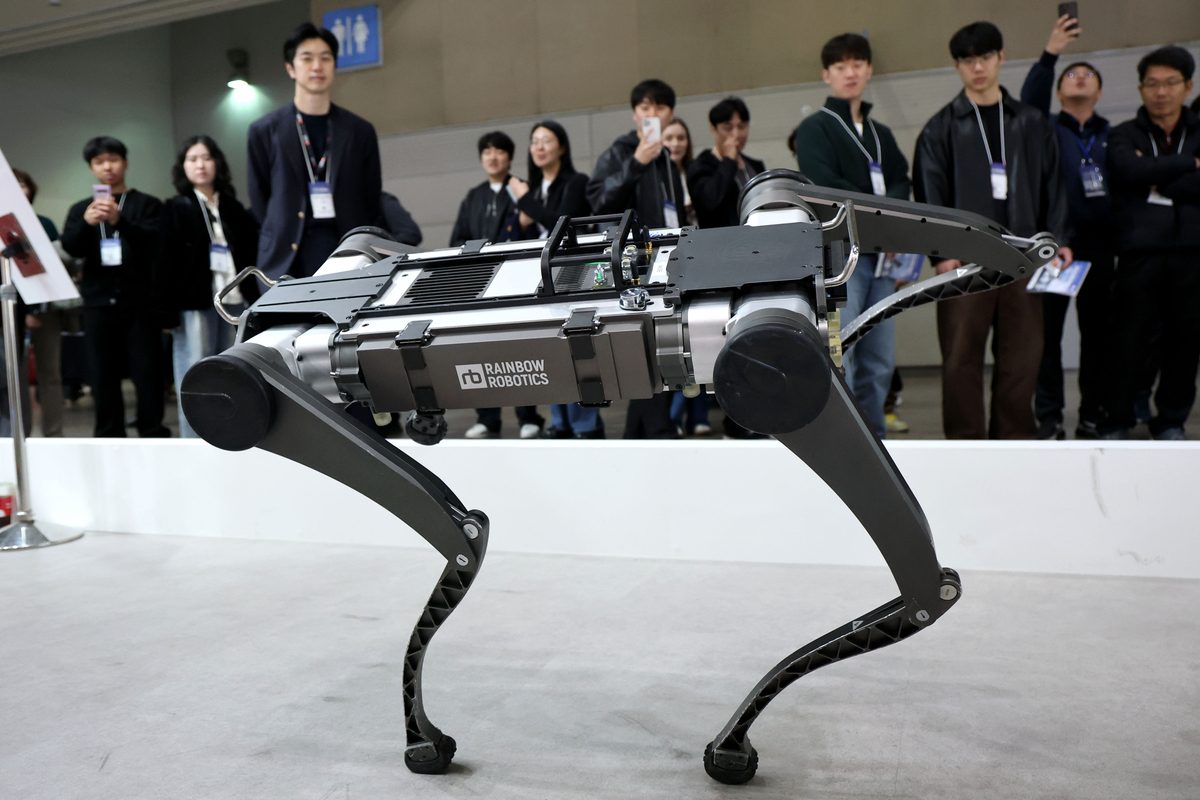
Rainbow Robotics demonstrated its RBQ-10 quadruped robot vaulting onto a 1-meter-high platform at RobotWorld 2026, which opened November 4 at KINTEX in Goyang, South Korea. The demo, reported by the Seoul Economic Daily, came as the company confirmed 30 RBQ-10 units have completed proof-of-concept testing this year, with mass production targeted for 2027.
What can the RBQ-10 actually do?
The RBQ-10 weighs 42 kg and measures 98 x 43 x 62 cm, with a top walking speed of roughly 9 km/h and up to 14 km/h in running mode. It carries a 15 kg payload, climbs slopes up to a 45% grade and 20-25 cm steps, and runs for roughly two hours per charge on a swappable battery, extendable to about four hours. An IP54 rating lets it operate in rain and dust, and it ships with stereo RGB-D cameras, an IMU, and optional 3D LiDAR for inspection and patrol tasks. Rainbow Robotics says it defaults to dynamics-based gait control for predictable walking, switching to reinforcement-learning-based gaits for slippery or high-speed terrain.
Why does a 1-meter vault matter for a patrol robot?
Jumping onto a platform is a proxy test for the kind of unstructured terrain the RBQ-10 is built to patrol — loading docks, stairwells, rubble, or shipyard gangways where wheeled robots stall. A company official quoted by Seoul Economic Daily said the focus has been on making the robot move reliably over varied terrain once deployed, rather than on the trick itself. That framing matters because quadrupeds have struggled to move from stage demos to paid field contracts; Rainbow Robotics is positioning the vault as evidence the platform has crossed that line, with 30 units already in proof-of-concept use.
How does this compare with other quadruped makers?
Rainbow Robotics, which also builds the RBY mobile humanoid, is competing in a quadruped field increasingly dominated by Chinese manufacturers like Unitree and Deep Robotics on price, and by ANYbotics on heavy-industry certification. The RBQ-10's pitch leans on South Korea's domestic defense, security and heavy-industry demand — Rainbow Robotics lists shipbuilding, defense and outdoor patrol as target use cases, markets where Korean conglomerates may prefer a domestic supplier over importing from China.
What happens between now and 2027?
With proof-of-concept testing already covering 30 units, Rainbow Robotics' next step is converting that pilot fleet into paying customers before mass production begins. The company has not disclosed pricing, but its showcase alongside the RBY humanoid at RobotWorld 2026 — an event drawing 402 exhibitors from 17 countries — suggests it's using the conference to line up industrial and defense partners ahead of the 2027 production ramp.