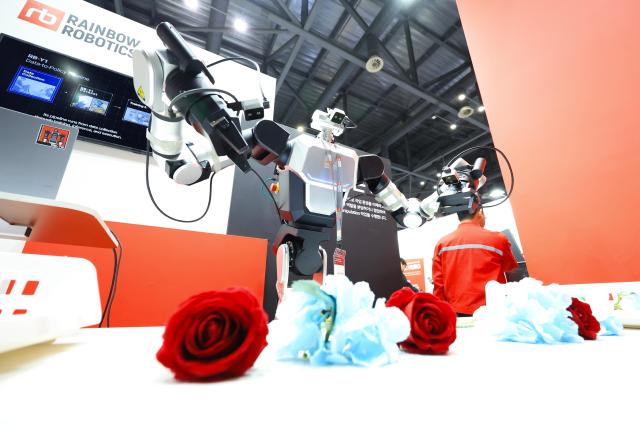
RobotWorld 2026 opened November 4 at KINEX in Goyang, South Korea, drawing 402 exhibitors from 17 countries for a show organized around physical AI and AI-driven manufacturing. Chinese robot maker Unitree drew crowds with G1 humanoids dancing to K-pop and its robot dogs trotting through the aisles, while Korean firms Rainbow Robotics, Robotis and Aei Robot used adjacent booths to show machines built for factory floors rather than performances, according to Aju Business Daily.
The contrast framed much of the show's opening day. Rainbow Robotics displayed its HUBO lineage alongside the RB-Y1, a mobile humanoid built to sort flowers, of which the company says it has sold nearly 200 units worldwide. Robotis showed its AI Sapiens humanoids, and Aei Robot demonstrated its ALICE biped, which it says can lift 20 to 30 kilograms, alongside its EDIE companion robot. The show also runs the 2026 International Robot Business Conference, with 36 breakout sessions on manufacturing AI and humanoid deployment.
A Split Between Spectacle and Deployment
Rainbow Robotics co-founder Sean Jee summarized the Korean industry's framing bluntly at the show: "Dancing robots keep coming out, but working is a completely different problem." It is a direct jab at Unitree and other Chinese humanoid makers, which have built marketing momentum this year through viral demonstrations, including robots racing up mountains and sparring in staged boxing matches, while facing persistent questions about how much of their on-stage choreography is autonomous versus scripted or teleoperated.
Korean exhibitors instead emphasized duration and payload over novelty. Aei Robot's Kim Ui-jin framed the distinction as one of endurance rather than capability: "Walking for a moment and walking all day were completely different problems." That argument lines up with Korea's broader industrial posture. The country runs 1,220 industrial robots per 10,000 manufacturing workers, the highest density in the world as of 2024, giving its robot makers a domestic customer base of factory operators who will tolerate a less flashy demo if the robot works a full shift reliably.
Why the Comparison Matters Beyond One Trade Show
The split at RobotWorld echoes a broader pattern in the global humanoid race. Chinese manufacturers including Unitree, AgiBot and Xiaomi have scaled unit shipments and cut prices aggressively, leaning on a domestic supply chain for actuators, batteries and sensors that keeps hardware costs down even as profit margins across the sector compress. Korean suppliers, by contrast, are leaning on deployment credibility, pointing to units already working alongside humans in logistics and manufacturing settings rather than headline shipment counts.
Both strategies carry risk. China's volume-first approach depends on finding enough paying industrial customers to justify the capital pouring into the sector, at a time when China's robot funding overall has fallen sharply from its prior peak amid tighter IPO standards. Korea's slower, deployment-first approach risks ceding the consumer and brand visibility that drives investor and government attention, even if its machines work longer shifts. South Korea's government has backed the deployment-first strategy with subsidies aimed at getting robots onto factory floors rather than into consumer demos, part of a broader push to offset a shrinking manufacturing workforce. That policy tilt gives Korean robot makers a captive early market most Chinese competitors still have to build from scratch outside China, even as it does less to generate the viral attention that has helped Chinese humanoid makers attract global investors. RobotWorld's exhibitor list, split roughly between flashy Chinese humanoids and workmanlike Korean platforms, suggests neither country has resolved which approach wins the next phase of the humanoid market, only that each is betting its home advantage is the more durable one.