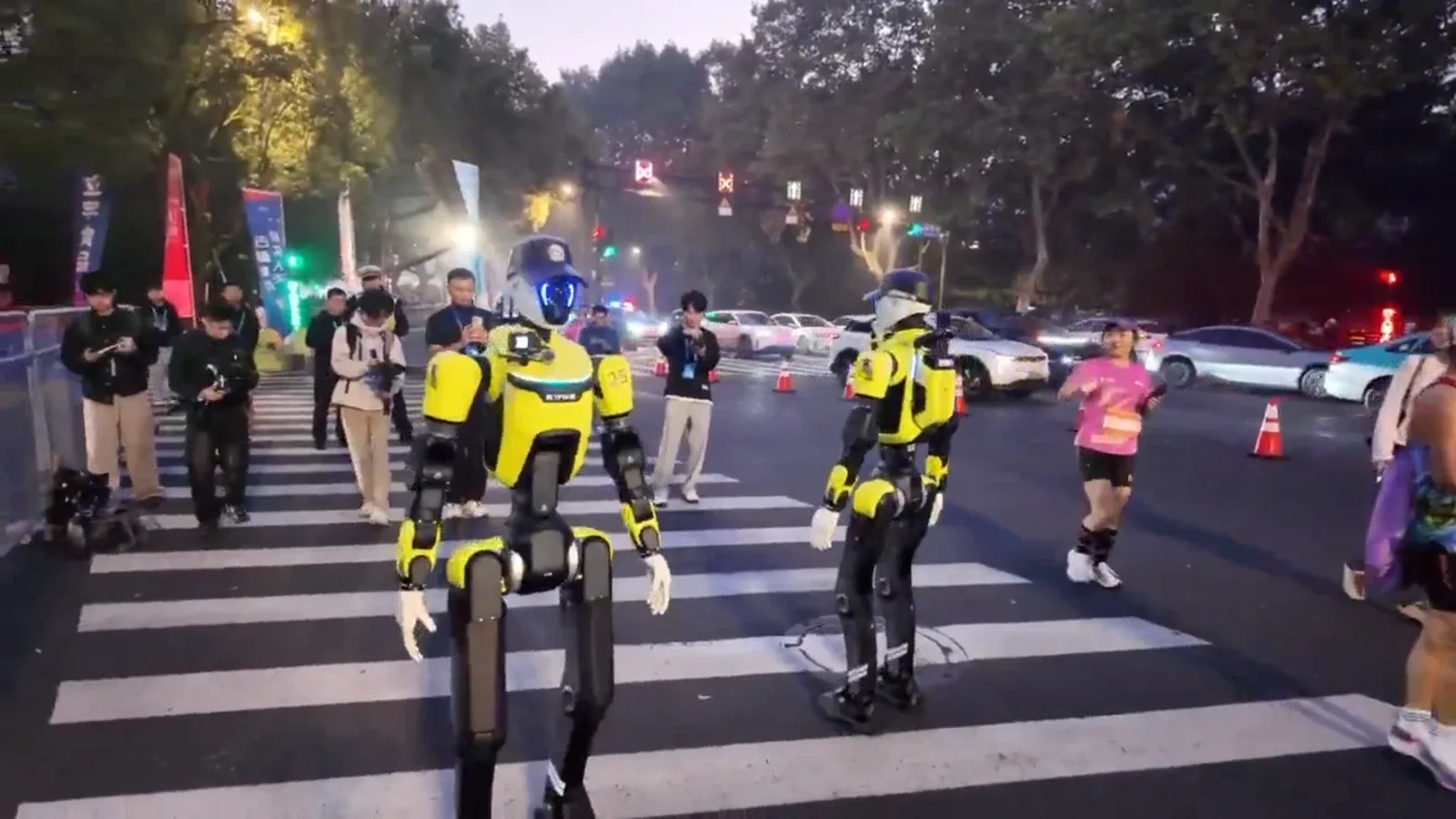
A humanoid robot joined China's traffic police on patrol at a major public event this week, directing runners and pedestrians at the 2026 Hangzhou Marathon on November 1. The robot, named Hangxing No. 2, was built by Hangzhou-based DEEP Robotics in partnership with local traffic authorities and worked alongside human officers at intersections near Huanglong Sports Center, according to reporting on the deployment.
The marathon drew roughly 300,000 applicants for 36,000 available runner slots, making it one of the larger road races on China's crowded fall racing calendar and a dense, time-boxed test case for putting a humanoid robot into a real public-safety role rather than a lab demo.
What does the robot actually do at an intersection?
Hangxing No. 2 is built on DEEP Robotics' DR02 humanoid platform, stands about 178 centimeters tall and carries an IP66 rating, meaning its housing is sealed against dust and heavy water jets, a baseline requirement for anything working outdoors in changeable weather. DEEP Robotics says the unit is rated to operate between -20°C and 55°C. On race day, the robot worked as part of a four-point patrol team spread across the course's busiest junctions, with human officers covering the remaining posts. Its job list included monitoring a fixed intersection, running preset patrol routes, issuing warnings when it detected traffic violations, and answering basic questions from the public, all while performing the same hand gestures a human traffic officer uses to direct cars and runners.
Those tasks were chosen deliberately for their repetitiveness. "Marathon security is concentrated in time, with dense crowds and highly repetitive tasks, which makes it a good scenario for robots to take on first," said Meng Yuan, a DEEP Robotics representative, describing the deployment as an early attempt to build a standard model other cities could reuse for large running events.
Is this more than a publicity stunt?
China's humanoid makers have spent the back half of 2026 looking for visible, low-risk settings to put robots in front of the public, from robots racing up Mount Tai carrying eggs to pilot programs in hospitals and warehouses. A marathon traffic post fits the same pattern: the task is narrow, well-defined and heavily supervised by human officers, which limits the consequences if the robot gets something wrong, while still generating footage that signals progress to investors, regulators and the public.
What makes the Hangzhou deployment somewhat more substantive than a one-off photo opportunity is the direct partnership with municipal traffic police, who helped shape the unit's task list rather than simply hosting a robot for a demo. DEEP Robotics, better known internationally for quadruped robots used in utility and energy inspection, is one of several Chinese robotics firms, alongside AgiBot and Unitree, now pushing humanoid hardware into public-service roles as a way to differentiate from rivals focused purely on factory and warehouse deployments. Whether traffic-control robots become a recurring fixture at Chinese road races, rather than a one-marathon experiment, will depend on how the unit performs outside a single, heavily staffed event.