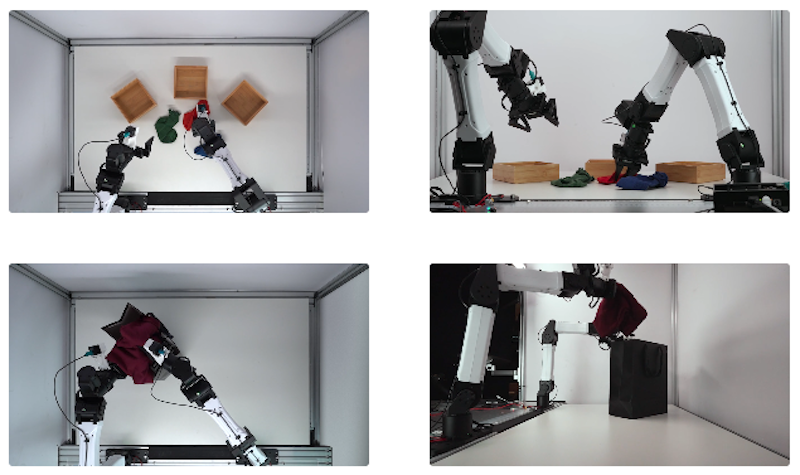
Runway made its Praxis-1 robot foundation model publicly available on November 22, 2026, releasing the 27-billion-parameter model's weights, inference software and fine-tuning tools under an Apache 2.0 license. The model, first introduced in September 2026, combines video prediction with robot action generation so that systems can learn physical tasks from general video footage rather than relying solely on robot-specific demonstration data, according to Robotics and Automation News.
On the RoboLab-120 benchmark, Praxis-1 posted a 46.2% success rate, ahead of FLUX 3 Action (42.9%), Nvidia's Cosmos 3 Nano (36.8%) and Physical Intelligence's π0.5 (28%). After fine-tuning for Google's RT-1 robot on the SimplerEnv benchmark, Praxis-1 reached an 80% success rate, well above RT-1's own baseline of 52.4%.
Why an Open Weight Release Matters Here
Most comparably sized robot foundation models have shipped as closed, API-gated products, including Nvidia's Cosmos line. Runway's decision to publish full weights on GitHub and Hugging Face, with support for the LeRobot framework, hands smaller robotics teams a model they can fine-tune on their own hardware without paying per-call API fees or sending proprietary task data to a third party.
That matters because the practical bottleneck in embodied AI right now isn’t raw model capability, it's getting any one model to generalize across the dozens of arm, gripper and mobile-base configurations startups actually use. An open-weight release lets a hardware maker adapt Praxis-1 directly to its own robot rather than waiting for a vendor to add support, which is exactly how Runway demonstrated the model, in partnership with Noble Machines, Standard Bots and Ultra across industrial arms, dual-arm warehouse robots and humanoid platforms.
The Benchmark Gap Versus the Deployment Gap
The RoboLab-120 numbers put Praxis-1 roughly 3 to 10 percentage points ahead of its closest named rivals, a real but incremental lead rather than a decisive one. Runway itself has flagged the limits plainly, acknowledging the model "still struggles with visually similar objects, ambiguous instructions and complex tasks requiring multiple sequential actions," which covers a large share of real warehouse and factory picking scenarios.
The more consequential number may be the SimplerEnv jump, from 52.4% to 80% after fine-tuning on RT-1 specifically. That suggests Praxis-1's video-pretrained foundation transfers well to new hardware with comparatively modest additional training, which is the quality that determines whether a foundation model actually displaces bespoke, single-robot policies. Nvidia, Physical Intelligence and Google's own RT-X lineage will all be judged against that same transfer-efficiency bar going forward, not just raw success rates on a fixed benchmark.