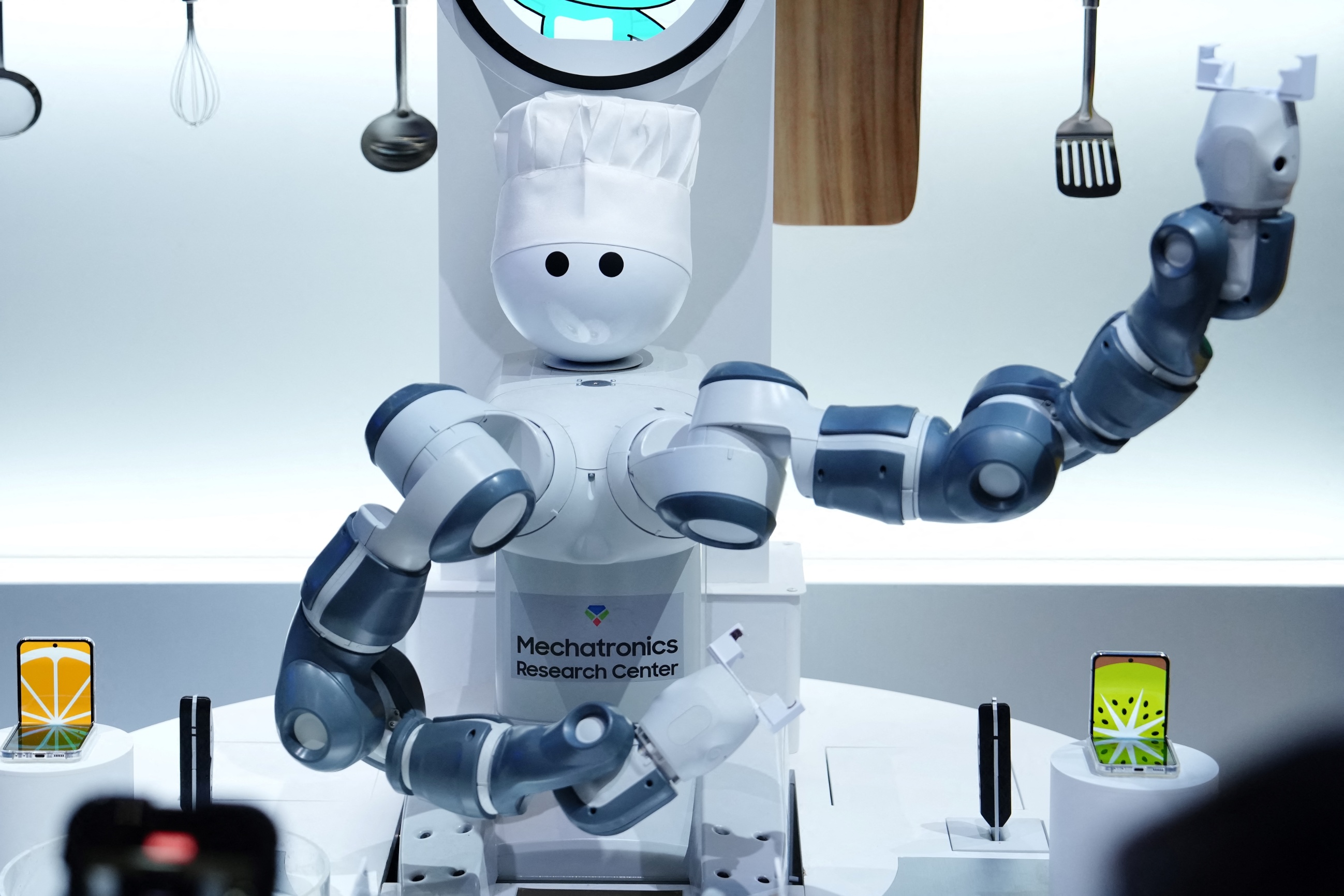
Samsung Electronics officially launched its Robotics eXperience (RX) Business Promotion Office on July 21, 2026, consolidating years of scattered robotics work into a single CEO-controlled unit and declaring — in the clearest organizational language a corporation can offer — that humanoid robots are its next major business. Unlike a typical launch announcement, Samsung came with a robot AI system already proven in a factory.
Shallow-π: The Robot Brain That Already Works
Before the division's ink was dry, Samsung Research had already published Shallow-π, a Vision-Language-Action (VLA) model that compresses AI control steps to roughly one-third of previous system requirements and makes 17 decisions per second. In rigorous field testing it achieved a 95% success rate on ultra-precision water hose insertion tasks requiring sub-millimeter accuracy, and coordinated 22 degrees of freedom across dual robot arms and hands in just 40 milliseconds — a level of real-time dexterous control that competing programs have not publicly demonstrated at equivalent precision. The robot brain, in other words, already works.
Reporting Line Is The Strategy
The most consequential feature of RX is its reporting line. Rather than sitting inside product management or being delegated to a subsidiary, the unit operates directly under Samsung Device eXperience CEO TM Roh. Executive Vice President Lee Dongkun — who previously led robotics strategy at Hyundai Motor Group and Boston Dynamics — was hired in May 2026 to head strategy. Samsung also recruited Seoul National University professor Hyun-Jin Kim and Ajou University professor Eui-Kyum Kim, one of Korea's foremost researchers on robot hand design.

The Gumi Robot Data Factory: Samsung's AI Moat
The most strategically significant element of Samsung's plan is not the org chart or the capital commitment — it is the data architecture. Samsung will establish its primary R&D hub at its Umyeon-dong campus in Seoul and build a Robot Data Factory at its Gumi facility in North Gyeongsang Province. Robots on Samsung's own production lines will perform material transport and assembly, and the execution data will feed back into VLA model training in a continuous loop. Digital twin simulations built on NVIDIA's Omniverse platform will complement more than 50,000 NVIDIA GPUs Samsung has already deployed across its manufacturing network.
Factories First, Consumers Later
Samsung's deployment sequence is explicit: industrial robots in its own factories first, B2B commercial deployments to other manufacturers second, general-purpose consumer robots third. The Phase 1 target — transform all of Samsung's global manufacturing sites into "AI autonomous factories" by 2030 — is one of the most ambitious automation targets any major electronics company has made public. Samsung has said it will pursue further investment and acquisitions to accelerate the timeline, on top of its roughly 35% stake in Korean humanoid maker Rainbow Robotics, whose RB-Y1 platform provides a working hardware base.
The Competitive Field
Samsung enters a crowded arena. More than 300 humanoid companies operate globally; Unitree Robotics is shipping humanoids at roughly $16,000 per unit, Tesla's Optimus program is being fabricated on Samsung's own Taylor, Texas foundry, and Figure AI's Figure 03 platform is deployed in manufacturing environments. Shares of Samsung Electronics rose 6.76% on the news, outpacing a roughly 4% rise in the benchmark Kospi index.
Reporting based on coverage from Tech Times, CNBC, Investing.com, Sedaily, GSMArena and Samsung Research.