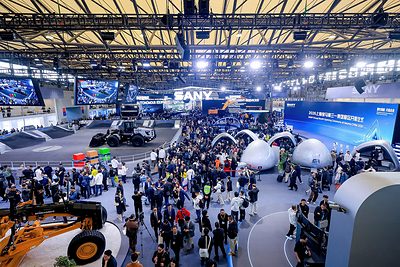
Chinese construction equipment maker SANY used bauma CHINA 2026 to show off a fleet of autonomous, cab-free heavy machines, including a 100-tonne mining truck that recharges in under 35 minutes and a paving system where one person with a tablet oversees up to 15 machines at once. The announcements were made November 24-25 at the trade show, according to SANY's press release.
The centerpiece is the SKT165Ei, which SANY describes as the industry's first cab-less 100-tonne autonomous battery-electric mining truck. It runs on an 800-volt platform with 2C fast charging, meaning it can recharge in under 35 minutes rather than the hours a standard electric heavy vehicle needs. Removing the driver's cab also freed up 12% more payload capacity. The truck loads, hauls and dumps material on its own under cloud dispatch, and SANY says it keeps working even where network coverage is weak, relevant for remote mine sites with patchy connectivity.
How does one person supervise 15 machines?
SANY's paving fleet pairs cab-less pavers with its new SSR360C-10E roller, an all-electric machine with no driver's seat that runs more than 12 hours on over 1,000 kWh of battery. Instead of each machine needing its own driver, a multi-agent scheduling system coordinates the fleet automatically, lifting efficiency by more than 20% while holding path-tracking accuracy to within 5 centimeters. A single operator monitors the entire group from a tablet rather than climbing into each cab.
This isn't a lab demo: SANY says its driverless paving fleets have already logged more than 5,000 kilometers across more than 60 real projects since they were first deployed commercially in 2019, including one stretch where a fleet ran 480 hours straight on a single expressway job without stopping for a human shift change.
Why is construction catching up to warehouses and factories?
Construction and mining have lagged behind warehouse and factory automation because job sites are unstructured, outdoors, and constantly changing, exactly the conditions that make scripted robot behavior fail. SANY's approach leans on fleet-level AI coordination rather than trying to make any single machine fully autonomous in isolation, which is closer to how mining giants like Rio Tinto and Fortescue already run autonomous haul truck fleets at scale in Australia.
SANY also previewed an early-stage all-electric excavator robot prototype called E-MOVE and a new AI platform, SanVIST, running an agent called SANY Neo that handles project operations, repair diagnosis and parts identification. The global construction robot market was valued at roughly $4.2 billion in 2025 and is forecast to reach $13.5 billion by 2036, and heavy-equipment makers are racing to own the autonomy layer before software-only robotics startups move in.
What's next?
SANY hasn't disclosed pricing or a commercial rollout date for the SKT165Ei mining truck or the SSR360C-10E roller, and the E-MOVE excavator remains a prototype. But the 480-hour continuous paving run and the six-year commercial track record for its driverless paving fleets suggest SANY is further along in real-world deployment than the splashier mining truck reveal might suggest on its own.