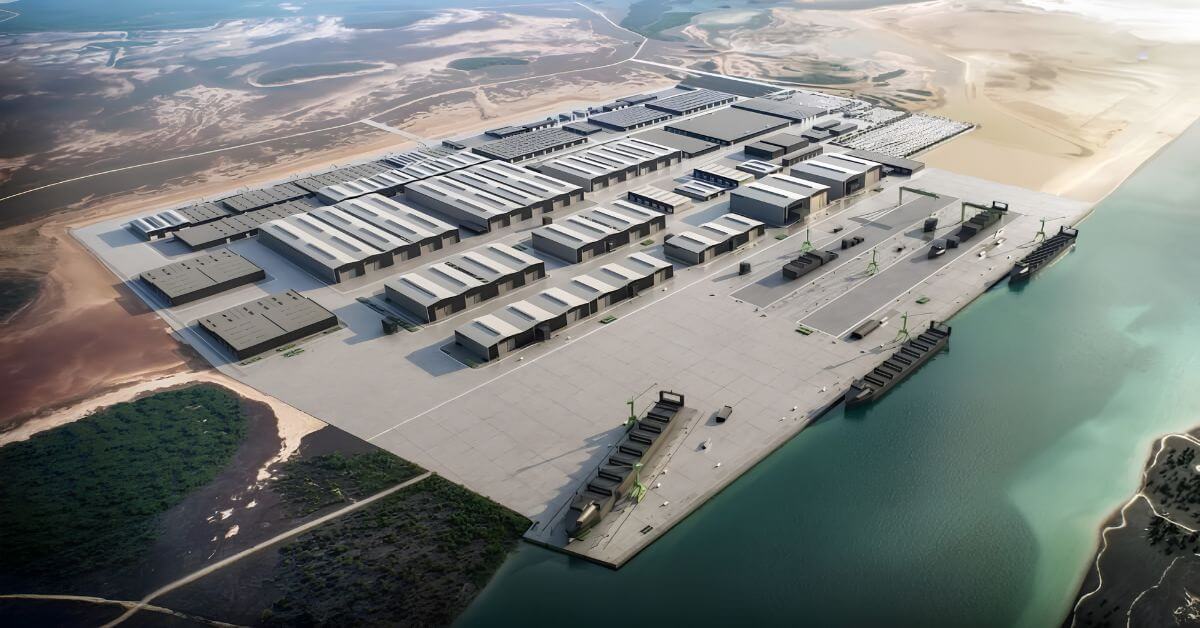
Autonomous-ships specialist Saronic Technologies is expanding beyond drones with a US Navy contract to build a new class of Landing Craft Utility (LCU) vessels at its Port Alpha shipyard in Brownsville, Texas — its first traditional shipbuilding program alongside a fast-growing autonomous fleet.
First Crewed Navy Ship For A Company Built On Autonomy
Awarded under an Other Transaction Authority (OTA), the firm fixed-price agreement covers a series of LCUs capable of ferrying up to 170 tons of personnel, vehicles and supplies from offshore staging areas onto beaches over a range of roughly 1,200 nautical miles. LCU production is set to begin in 2028 with initial deliveries in 2029, replacing an aging Navy landing craft fleet that has been running short of hulls for amphibious operations. It marks the first crewed program for a company that has, to date, sold only uncrewed platforms.
Port Alpha Turns Into A Dual-Use Yard
The award anchors Saronic's Port Alpha shipyard, unveiled earlier this year as a $2.5 billion Gulf-coast facility designed for both autonomous and traditional Navy shipbuilding. The yard is scheduled to open in 2028 with capacity for vessels up to 850 feet, with potential expansion to 1,200 feet, and could employ as many as 10,000 workers at full scale. That capacity now backstops the Corsair, Marauder and Mirage autonomous lines and a separate $400+ million Corsair OTA — as well as the new LCU program.

A Navy Betting On Non-Traditional Shipbuilders
The LCU award continues a Navy push to onboard non-traditional shipbuilders as legacy yards struggle to meet demand. Saronic, valued at $9.25 billion after its $1.75 billion Series D closed earlier this year, joins a broader wave of tech-native primes taking on both robotic and crewed programs. The company recently launched its 150-foot Marauder MUSV and its 52-foot Mirage ASV, and its Corsair ASV recently helped rescue US Apache pilots near the Strait of Hormuz.
Reporting based on coverage from Benzinga, Marine Insight, MarineLink and WorkBoat.