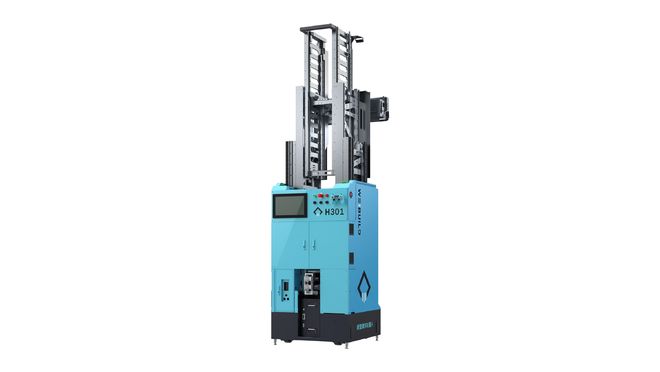
Shanghai Weijian Technology, which builds automated plastering and steel-reinforcement robots for construction sites, has closed a Series C round of more than 100 million yuan (roughly $14 million), led by Caitong Capital. The round, the company's fifth financing event since it was founded in June 2020, was reported November 15, 2026 by 163.com, citing an exclusive from 36Kr.
The company said the capital will go toward manufacturing, overseas market expansion, and continued R&D in its embodied-AI construction robots.
What do Weijian's robots actually do?
Weijian's flagship product is an intelligent interior-wall plastering robot that works within a 2-meter-by-2-meter section of wall, autonomously executing three sequential steps — plastering, applying putty, and painting — without a human switching tools between stages. The company says the robot works at more than ten times the speed of a skilled human tradesperson.
Its product line spans the PMC-3000 and PMC-6000 plastering robots, the PNP-3000 and PNP-6000 spraying robots, and a flexible steel-reinforcement processing center, alongside supporting equipment like mortar mixers and pumps. Weijian says it holds 100% market share in the specific niche of fully autonomous plastering robots and intelligent rebar-processing systems, largely because few other Chinese robotics firms have entered that exact segment.
How is the money being used, and who backed it?
Caitong Capital led the new round outright. Weijian has not disclosed the identities of its earlier-stage backers in this announcement, but the company has raised capital across five rounds since 2020, with this Series C marking its largest disclosed amount to date. Projected 2026 product sales orders are expected to exceed 100 million yuan, representing more than 100% year-over-year growth, and the company says its order volume has compounded at over 100% annually for three consecutive years.
The company has already established subsidiaries in Singapore and Hong Kong and operates in Hong Kong, Taiwan, Singapore, and Dubai. In January 2025, its plastering robots passed acceptance testing with their first batch of United Arab Emirates clients. Partnerships include China State Construction domestically and Japan's Takenaka and several Middle Eastern builders internationally.
How does this compare to the rest of the construction-robotics field?
Construction automation has lagged behind warehouse and manufacturing robotics because job sites are unstructured, dusty, and constantly changing layout — conditions that are harder for a fixed robotic arm or wheeled platform to navigate reliably. Weijian's bet is that a tightly scoped task, finishing interior walls, is narrow enough to automate fully while still addressing a labor shortage that is acute across Chinese and Gulf construction markets.
Globally, most construction robotics plays — including bricklaying and rebar-tying systems from other startups — have struggled to move past pilot projects. Weijian's claim of a three-year streak of triple-digit order growth, plus live UAE deployments, suggests it has crossed further into commercial scale than many peers attempting similar single-task automation.
What to watch next
The company's next milestones are converting its Gulf pilot relationships into recurring contracts and proving its steel-reinforcement processing line can scale at the same pace as its plastering robots. Investors will also watch whether rivals enter the same narrow niche now that Weijian has shown commercial traction, eroding its claimed 100% share.