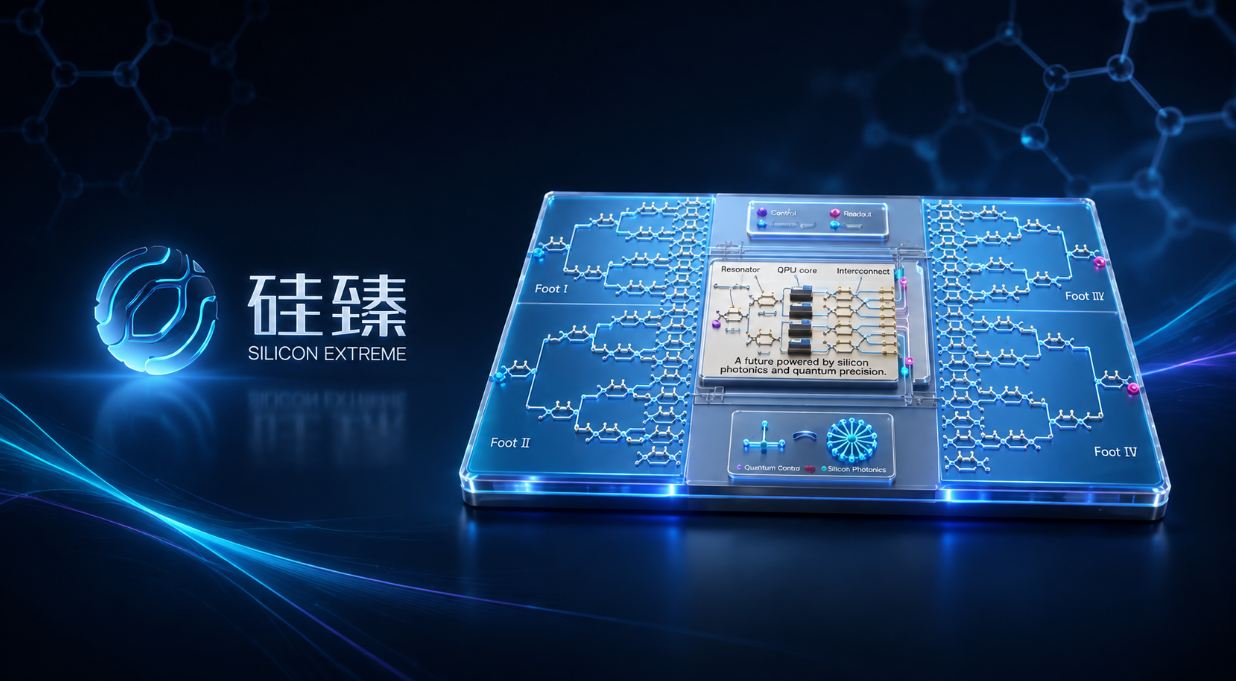
Hefei Sizhen Chip Technology and Prof. Ren Xifeng's group at the Key Laboratory of Quantum Information at the University of Science and Technology of China (USTC) reported this week that they have achieved the largest on-chip photonic entangled state to date: a stable 4-photon, 16-qubit Greenberger-Horne-Zeilinger (GHZ) state generated on a single programmable silicon photonic integrated circuit. The result was posted as an arXiv preprint, "On-chip generation of multi-qubit graph states with high-dimensional encoded single photons."
High-dimensional path encoding sidesteps photon scarcity
Multi-photon entanglement is the resource that powers optical quantum algorithms, but preparation probability collapses exponentially with the number of photons. Instead of chasing more photons, the Sizhen-USTC team encoded each single photon across 16 waveguide paths on a standard silicon-on-insulator (SOI) chip, packing four qubits of information into each photon as a 4-level qudit. A four-layer programmable measurement module then executes the entanglement, routing and single-qubit measurements required for a measurement-based quantum computing (MBQC) approach.
Grover at 98.7% and a 4-qubit cluster state
Using the same chip, the team prepared a single-photon 4-qubit cluster state and executed Grover's search algorithm with an average identification probability of 0.987. That accuracy is a meaningful jump over the prior on-chip photonic state of the art of 80.8% reported by the University of Stuttgart in July 2026. Genuine multipartite entanglement across 10 qubits of the 16-qubit GHZ state was verified via an entanglement witness.

Why MBQC matters for photonics
MBQC shifts the computational burden from executing gates at runtime to preparing large entangled resource states up front, then driving computation with single-qubit measurements. That trick sidesteps photonic quantum computing's longstanding lack of deterministic two-qubit gates and lends itself to fusion-based quantum computing architectures with higher fault-tolerance thresholds. Sizhen said the result makes a domestic path to million-qubit optical machines "feasible," a claim that will now be tested against rivals building on trapped-ion, superconducting and neutral-atom platforms including Quantinuum's Helios and photonic peers profiled in the sector.
Reporting based on coverage from The Quantum Insider, Quantum Computing Report, Pandaily and TechTimes.