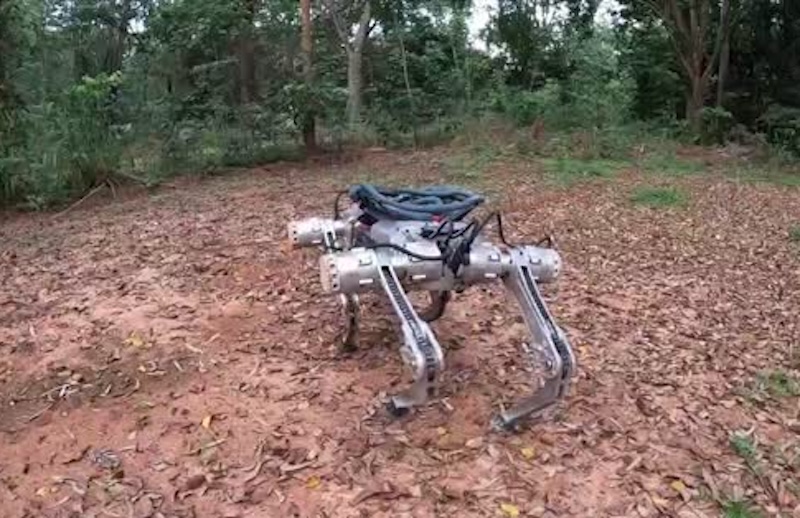
Bengaluru-based Strider Robotics has publicly demonstrated one of India's highest-payload quadruped robots, an autonomous four-legged platform capable of carrying 40 kilograms across uneven industrial terrain, as it moves from prototype into commercial deployment with pilots at a major oil and gas company and an automotive manufacturer.
India-designed platform hits industrial payload class
Founded by researchers who have worked on legged robotics since 2015 at the Indian Institute of Science (IISc) Bengaluru and IIT Madras, Strider says its latest robot combines high-torque actuators, a proprietary balance controller and onboard perception to walk stably under 40 kg loads. The company claims more than 80 percent of the platform's components by cost are indigenously produced, part of a push to build an India-based quadruped supply chain rather than depend on Chinese modules.
Field pilots inside dangerous plants
The robot is being deployed for industrial inspection, oil and gas facilities, mining, power plants, infrastructure monitoring, autonomous security patrols and disaster response. Strider says pilots are already under way with a large domestic oil and gas company and a car manufacturer, mirroring the same industrial inspection playbook that made Boston Dynamics' Spot and Kawasaki's new physical-AI platforms commercially viable.

A local answer to a booming global market
The commercial rollout lands as the global quadruped market races from under $1 billion last year toward more than $4 billion by 2035, with Taiwan-, China- and US-based platforms leading the pack. Strider's bet: an India-designed, India-built inspection dog paired with local integrators can undercut imported hardware at oil, gas and utility sites where uptime and total cost matter more than headline speed. The company was previously incubated at ARTPARK, the AI and robotics innovation hub at IISc.
Reporting based on coverage from Robotics and Automation News.