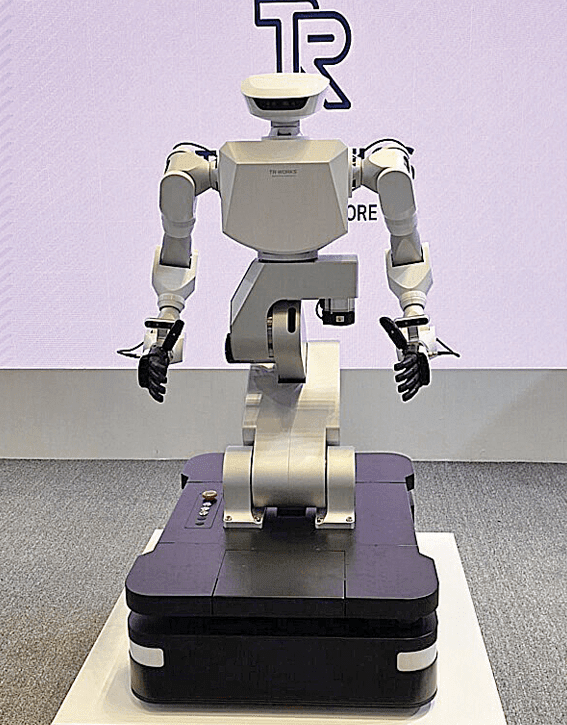
T-Robotics, a South Korean industrial robot and vacuum-robot maker, will bring its TR-WORKS industrial humanoid to CES 2027 in Las Vegas on January 6-9 — the company's first time exhibiting at the show — for its first public showing in North America. TR-WORKS combines an autonomous mobile robot base with a dual-arm upper body built on the company's vacuum-robot technology, and T-Robotics says it can run continuously for eight hours powered by the AMR platform. At the booth, the robot will perform live, real-time manufacturing-equipment operation tasks normally done by a human worker, according to Robot Newspaper.
The robot will show through the Korea-M.AX Alliance pavilion, organized with South Korea's Ministry of Trade, Industry and Energy, KEIT and KIRIA, and T-Robotics plans to use the show for direct meetings with international buyers. TR-WORKS first appeared publicly at Automation World 2026 in March and is now in proof-of-concept testing with major Korean manufacturers, validating whether it can handle real factory floor requirements rather than staged demos. T-Robotics expects to begin supplying commercial units starting next year.
A vacuum-robot pedigree, not a venture moonshot
T-Robotics isn't a venture-funded humanoid startup building hardware from scratch; it's an established robot maker with an existing AMR and vacuum-robot business, repurposing that manufacturing-automation experience and customer base into a humanoid platform. That's a materially different starting position than Figure, Apptronik or 1X, which raised hundreds of millions of dollars before shipping a single commercial unit. T-Robotics is instead betting that its existing relationships with Korean manufacturers — and a narrower task definition focused specifically on transport and equipment operation between production processes, rather than general-purpose dexterity — gets it to paying customers faster.
That narrower scope is also the company's main point of differentiation. Where Figure and Tesla's Optimus chase broad household and warehouse tasks, TR-WORKS is explicitly scoped to operate manufacturing equipment in place of a worker on a specific type of production line. It's a smaller addressable use case, but a more achievable one in the near term, echoing the approach Boston Dynamics took with its wheeled Stretch robot before chasing Atlas's more general mobility.
Competing inside Korea's crowded humanoid push
T-Robotics is entering an unusually dense domestic field. Hyundai Motor Group is mobilizing roughly 200 tier-one suppliers to build a Korean humanoid supply chain and plans a factory capable of 30,000 units a year for Boston Dynamics' Atlas. Samsung-backed Rainbow Robotics is targeting commercialization of its own advanced humanoid by 2028. Doosan Robotics, ROBOTIS and LG round out a government-encouraged domestic humanoid ecosystem chasing a national production target. South Korea's government has made humanoid manufacturing a named national priority, with public programs supporting field trials inside factories — access that gives smaller players like T-Robotics pilot sites a foreign startup entering Korea cold would not have.
Against that backdrop, a CES booth is less about beating Hyundai or Samsung on scale and more about getting T-Robotics in front of international buyers before the bigger Korean names crowd the conversation entirely. The risk is the same one every industrial humanoid entrant faces: proof-of-concept testing with unnamed major manufacturers is not the same as signed purchase orders, and T-Robotics has not disclosed unit pricing, order volumes or named customers. If the PoC results translate into actual deployments next year, TR-WORKS would be one of the earlier examples of a legacy industrial robot maker, rather than a pure humanoid startup, turning an existing customer base directly into humanoid revenue.