TensorWorld, the Beijing-based startup also known as WuYuan Technology (物原科技), has raised more than $100 million across two seed rounds completed within a month of its July 2026 founding, according to ifanr. An angel round was co-led by Cathay Capital and Sequoia China (HongShan), with IDG Capital, Dinghe VGC, Starchain Capital and Ant Group also participating; a follow-on angel-plus round was co-led by Ant Group, Heyu Capital and Meituan Strategic Investment.
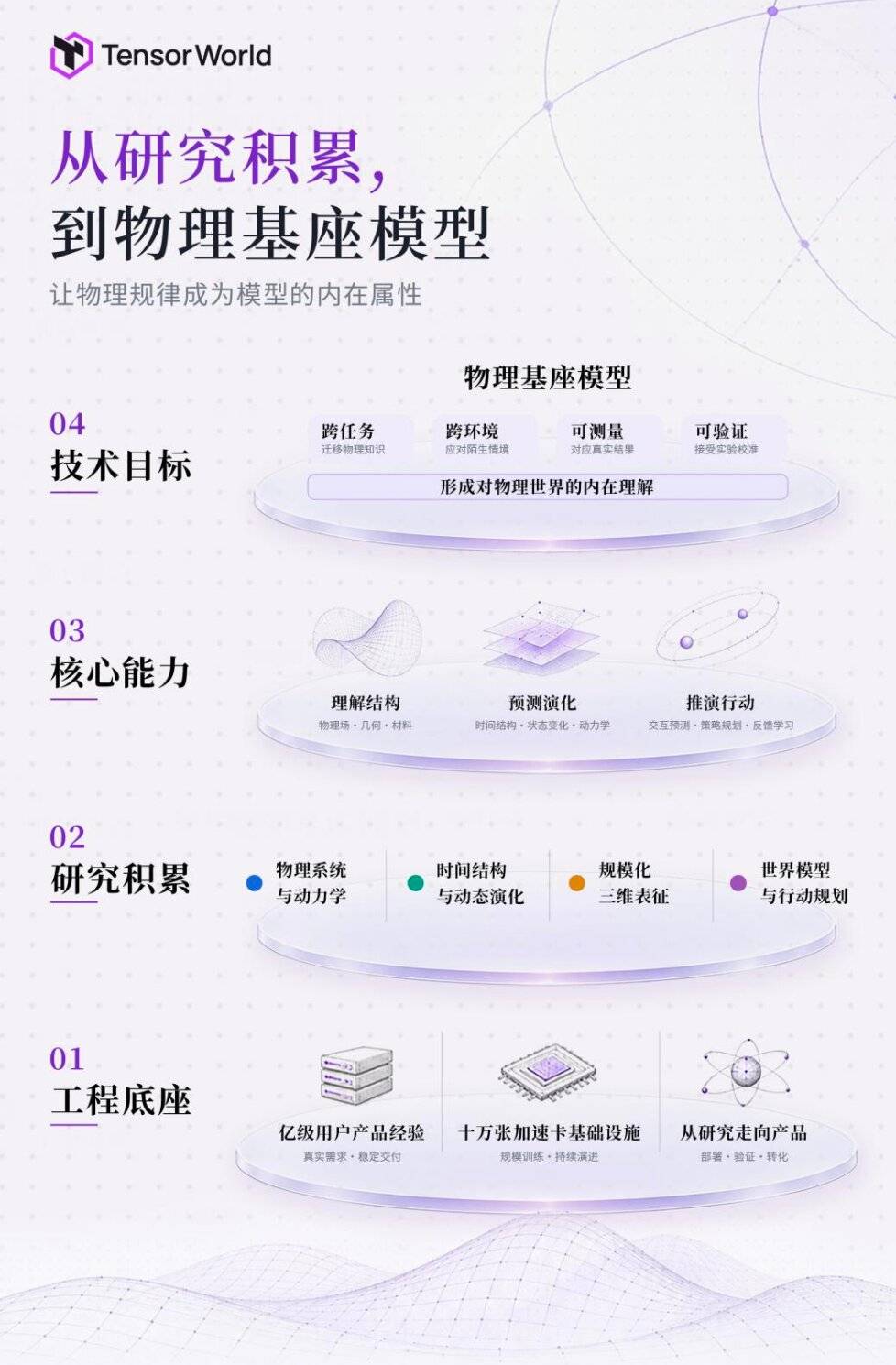
The company builds physics-native foundation models designed to learn how objects move, interact and respond to their environment from data, targeting robotics, autonomous driving and industrial simulation.
What TensorWorld is building
TensorWorld describes its approach as "constructing physical truth in tensor space" using synthetic dynamics rather than relying solely on captured real-world video or sensor logs. The company says this targets three persistent problems in training embodied AI: the cost of collecting physical interaction data, poor generalization of models across new scenarios, and the gap between simulated training and real-world deployment.
The founding team draws from Tsinghua University and MIT, with members who previously built products serving hundreds of millions of users and managed infrastructure spanning hundreds of thousands of accelerated GPUs, according to the company's disclosures.
Why the backers matter
Ant Group and Meituan's participation signals that China's largest consumer internet platforms see physical AI as adjacent to their existing businesses — Meituan runs one of the world's largest delivery and logistics networks, while Ant has pushed into robotics-adjacent fintech infrastructure. Sequoia China's involvement places TensorWorld alongside a wave of Chinese world-model startups that have drawn capital this year as robot makers look for a shared physical reasoning layer rather than training models from scratch for each hardware platform.
How this compares to the rest of the field
TensorWorld's $105 million seed is large even by the standards of China's heavily funded robotics sector, where overall robot funding has fallen 67% from its peak as Beijing tightens IPO standards. The raise is smaller than GenRobot AI's recent $100 million round for training data, but TensorWorld is explicitly targeting the physics-prediction layer rather than data collection itself, positioning it closer to Western physical-AI players building world models for robotics and autonomous driving.
What to watch next
With less than four months of operating history, TensorWorld has yet to disclose commercial deployments or named robotics customers. The near-term test will be whether its physics-native models can be integrated into third-party robot stacks quickly enough to justify the valuation implied by back-to-back rounds completed within weeks of launch.